📄 仓库 README
在 GitHub 查看 ↗





Ultralytics creates cutting-edge, state-of-the-art (SOTA) YOLO models built on years of foundational research in computer vision and AI. Constantly updated for performance and flexibility, our models are fast, accurate, and easy to use. They excel at object detection, instance segmentation, semantic segmentation, depth estimation, image classification, pose estimation, and oriented object detection tasks, and can track detected objects across video frames.
Find detailed documentation in the Ultralytics Docs. Get support via GitHub Issues. Join discussions on Discord, Reddit, and the Ultralytics Community Forums!
Request an Enterprise License for commercial use at Ultralytics Licensing.


📄 Documentation
See below for quickstart installation and usage examples. For comprehensive guidance on training, validation, prediction, and deployment, refer to our full Ultralytics Docs.
Install
Install the `ultralytics` package, including all [requirements](https://github.com/ultralytics/ultralytics/blob/main/pyproject.toml), in a [**Python>=3.8**](https://www.python.org/) environment with [**PyTorch>=1.8**](https://pytorch.org/get-started/locally/). [](https://pypi.org/project/ultralytics/) [](https://clickpy.clickhouse.com/dashboard/ultralytics) [](https://pypi.org/project/ultralytics/)pip install ultralytics
Usage
### CLI You can use Ultralytics YOLO directly from the Command Line Interface (CLI) with the `yolo` command:# Predict using a pretrained YOLO model (e.g., YOLO26n) on an image
yolo predict model=yolo26n.pt source='https://ultralytics.com/images/bus.jpg'
from ultralytics import YOLO

# Load a pretrained YOLO26n model
model = YOLO("yolo26n.pt")

# Train the model on the COCO8 dataset for 100 epochs
train_results = model.train(
    data="coco8.yaml",  # Path to dataset configuration file
    epochs=100,  # Number of training epochs
    imgsz=640,  # Image size for training
    device="cpu",  # Device to run on (e.g., 'cpu', 0, [0,1,2,3])
)

# Evaluate the model's performance on the validation set
metrics = model.val()

# Perform object detection on an image
results = model("path/to/image.jpg")  # Predict on an image
results[0].show()  # Display results

# Export the model to ONNX format for deployment
path = model.export(format="onnx")  # Returns the path to the exported model
✨ Models
YOLO27 — Coming Soon: Preview the upcoming family, currently undergoing final R&D. Models are not yet available, and no launch date is set.
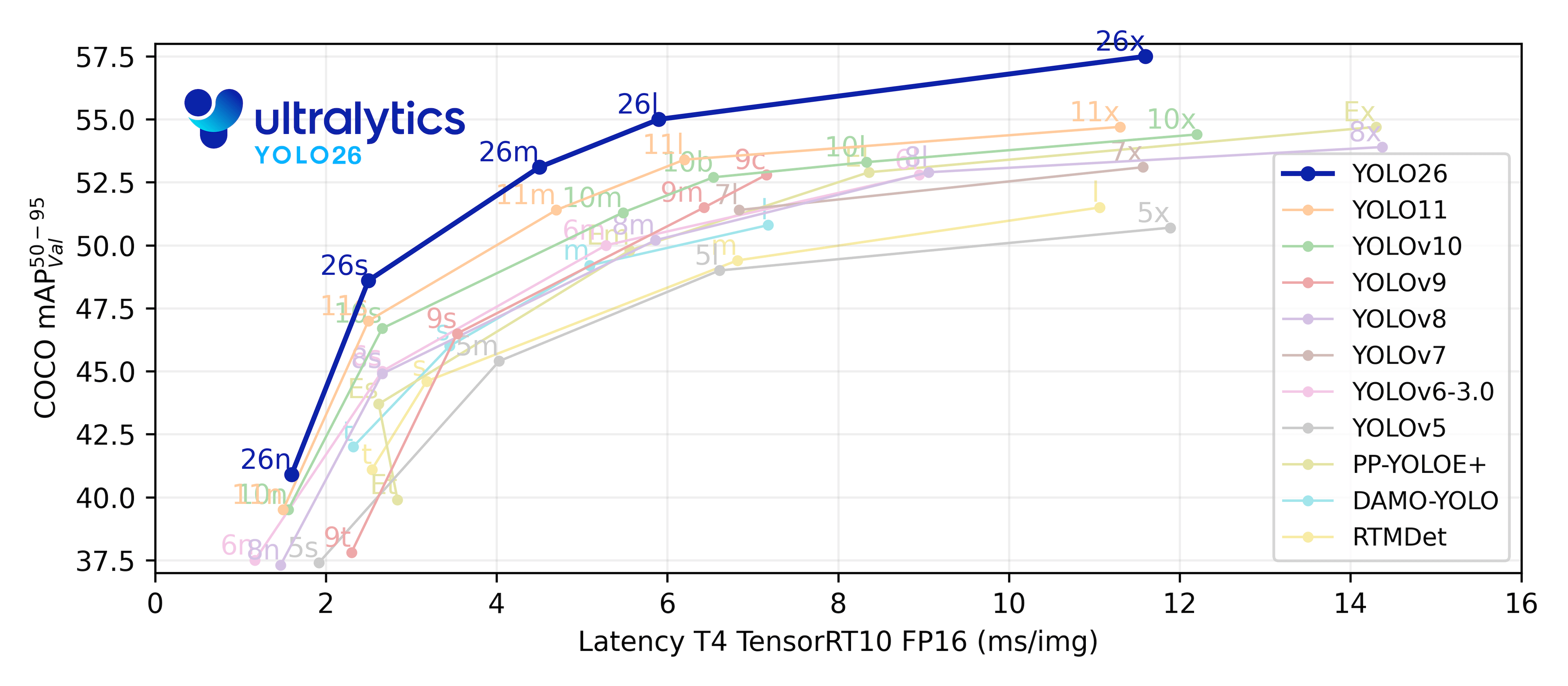
Ultralytics supports a wide range of YOLO models, from early versions like YOLOv3 to the latest YOLO26. The tables below showcase YOLO26 models pretrained on COCO for Detection, Segmentation, and Pose Estimation. Semantic Segmentation models are pretrained on Cityscapes, Depth Estimation models are pretrained on a broad multi-dataset mix and evaluated on NYU Depth V2, [Classification](https://docs.ultralytics.co
📈 近 7 天 Star 趋势
🏆 排名变化趋势
📋 历史上榜记录
| 日期 | 榜单 | 排名 | 周期新增 | 总 STAR |
|---|