📄 仓库 README
在 GitHub 查看 ↗code-review-graph
A local code knowledge graph that gives AI coding tools precise review context over MCP.
English | 简体中文 | 日本語 | 한국어 | हिन्दी






Usage · Commands · FAQ · Troubleshooting · GitHub Action · Reproducing the benchmarks · Roadmap
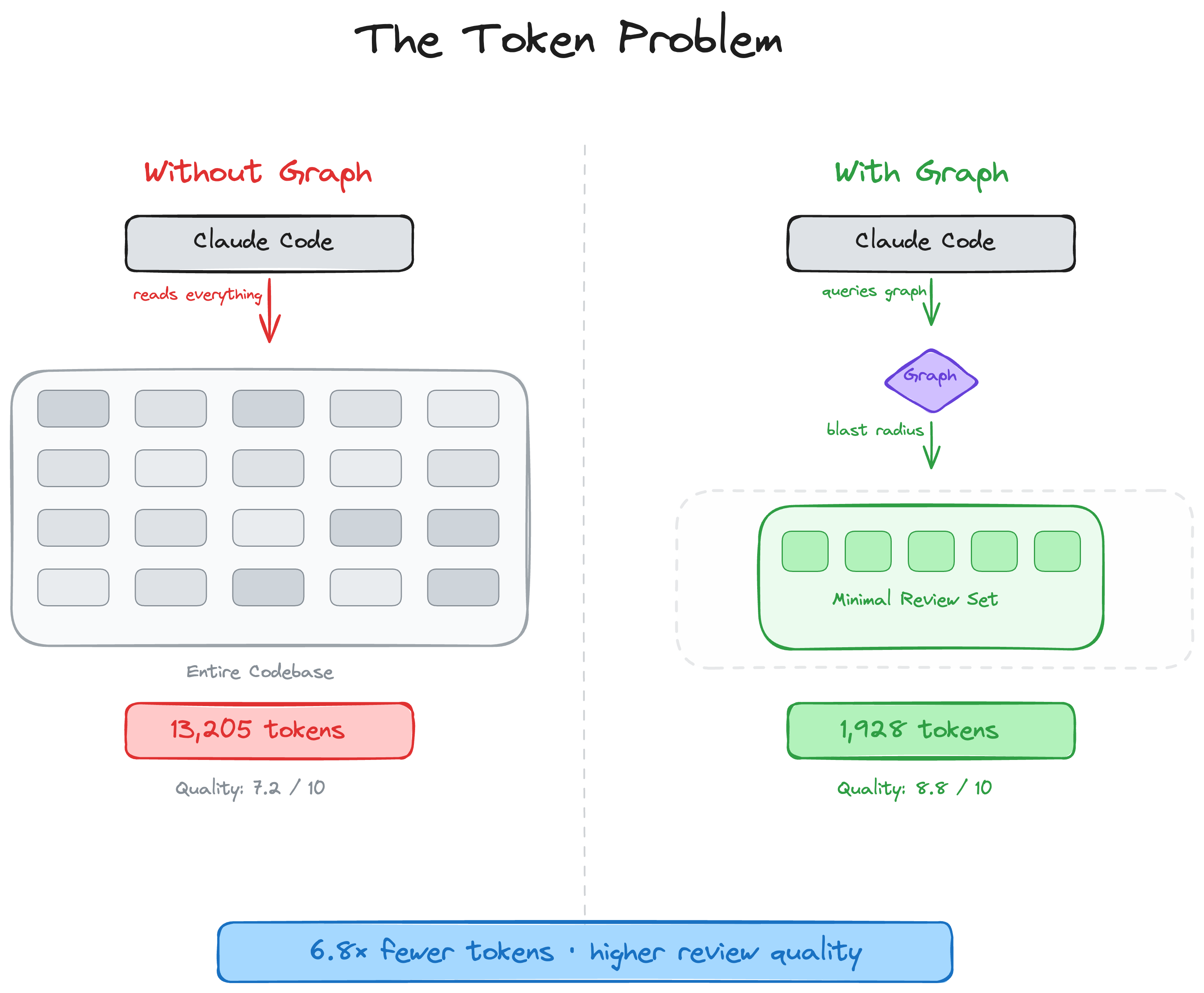
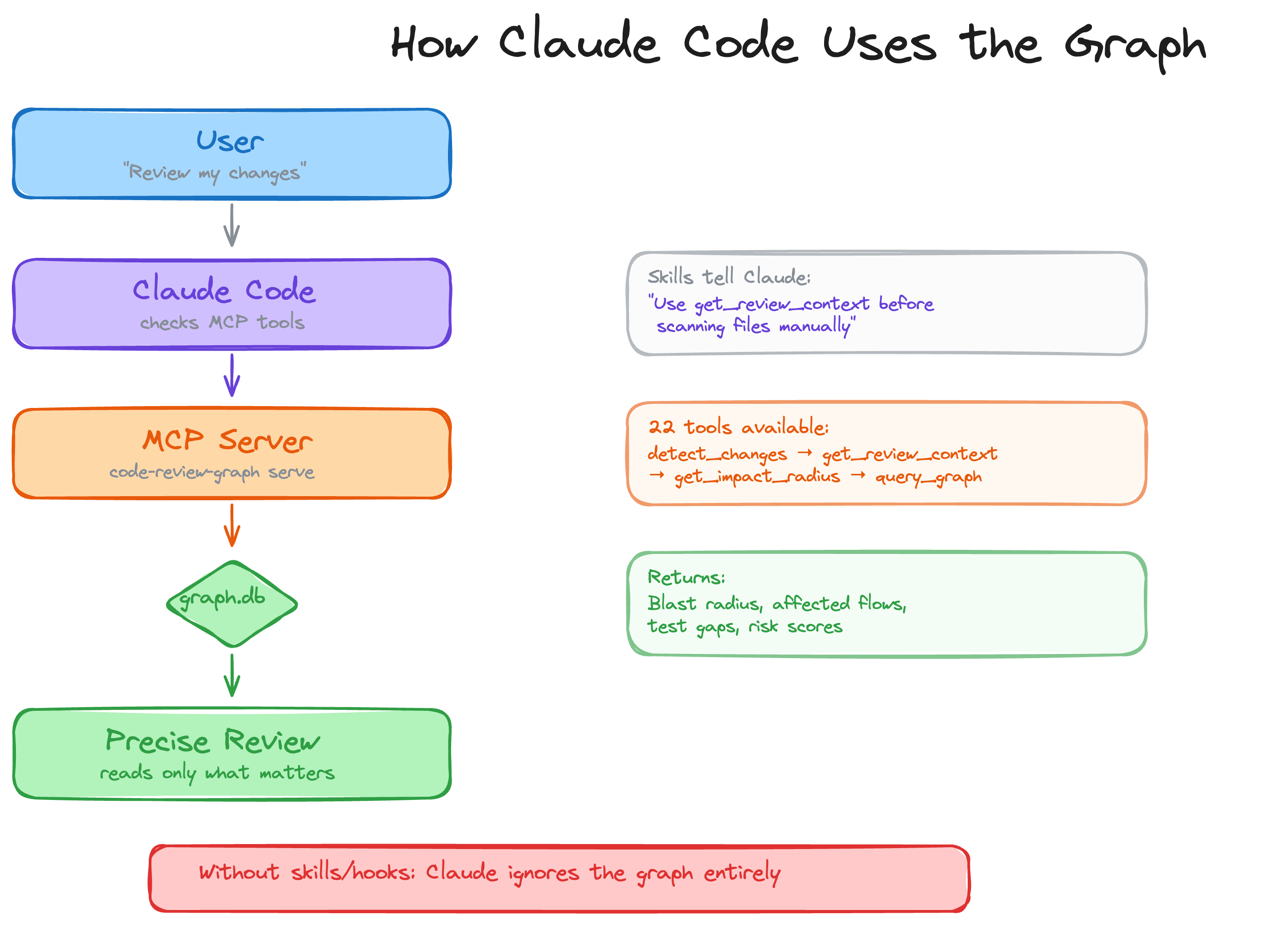
AI coding tools often re-read large parts of a codebase to review a change. code-review-graph builds a structural map of the code with Tree-sitter, keeps it updated incrementally, and serves compact context over MCP, so the assistant reads only the files a change touches.
Quick Start
pip install code-review-graph          # or: pipx install code-review-graph
code-review-graph install              # detect installed AI coding tools and configure each one
code-review-graph build                # parse the codebase
install detects which AI coding tools you have, writes an MCP server entry for each, installs hooks and skills where the platform supports them, and adds graph instructions to the platform's rules file. The MCP entry uses poetry run or uv run inside a Poetry or uv project environment, uvx code-review-graph serve when uvx is on PATH, and otherwise the current Python interpreter. Restart the editor or tool afterwards.
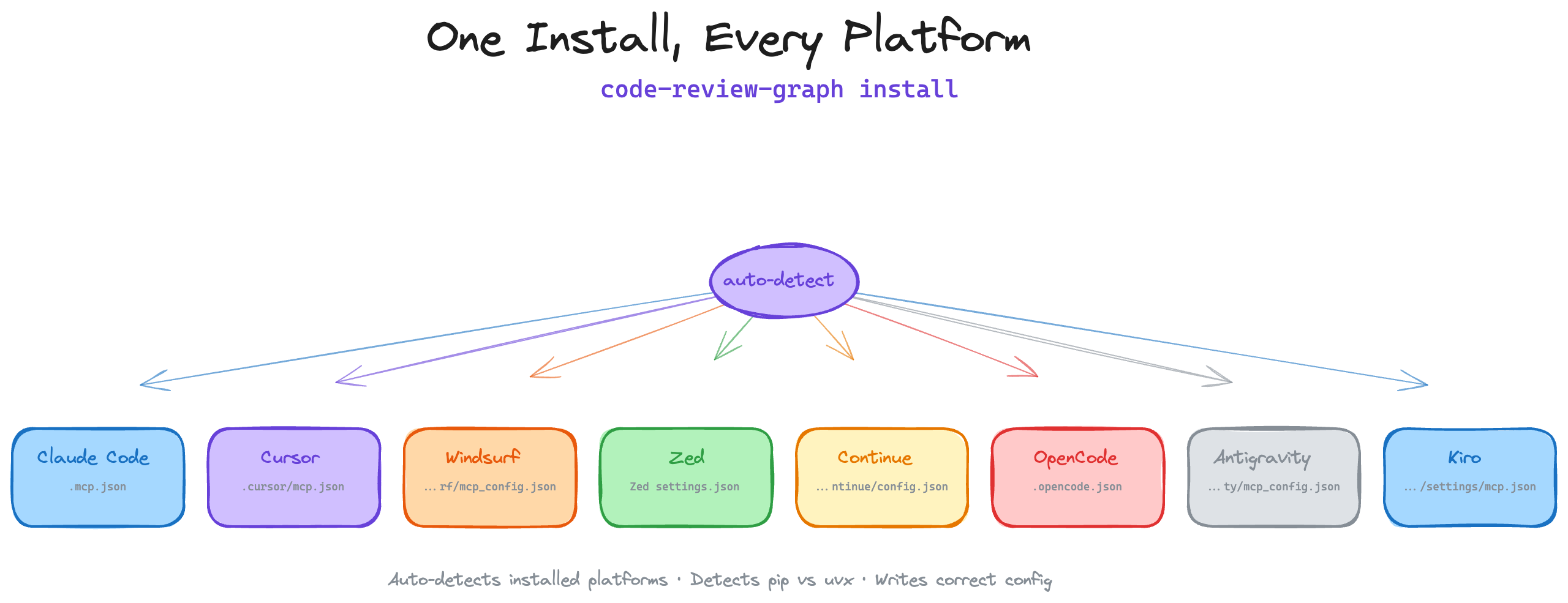
To configure one platform, pass --platform with one of codex, claude-code, cursor, windsurf, zed, continue, opencode, antigravity, gemini-cli, qwen, kiro, qoder, copilot, copilot-cli, codebuddy, or hermes:
code-review-graph install --platform cursor
code-review-graph install --platform codebuddy
Config file locations are listed in docs/USAGE.md. Requires Python 3.10+.
uninstall removes CRG-owned files and entries from a Git or SVN working tree and leaves other MCP servers, hooks, skills and JSONC comments alone. Run it from anywhere inside the tree. Shared config files are replaced atomically, so a failed write leaves the original intact.
code-review-graph uninstall --dry-run    # preview only
code-review-graph uninstall              # preview, confirm, apply
code-review-graph uninstall --yes        # apply without prompting
code-review-graph uninstall --all-repos  # also clean every registered repository
code-review-graph uninstall --keep-data  # remove integrations, keep graph databases
code-review-graph uninstall --keep-user-configs --repo .  # this project only
Then open the project and ask the assistant:
Build the code review graph for this project
Build time scales with repository size; a cold build of a ~3,000-file repository took about 40 seconds (measured). After that, hooks and watch mode keep the graph updated. If some files fail to parse, the result has status partial and names them in its summary; the CLI also prints a Warning: line on stderr, and those files keep their previous graph rows.
How It Works
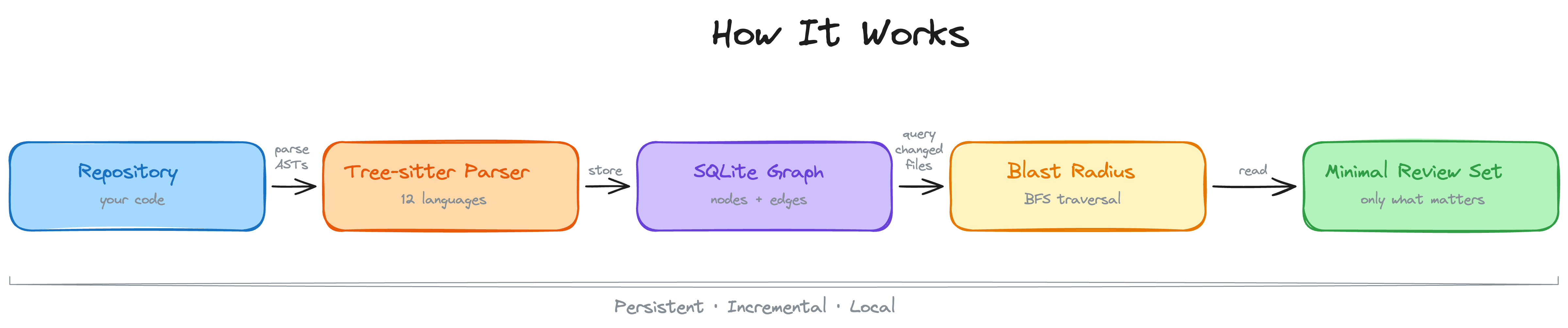
The repository is parsed into ASTs with Tree-sitter and stored as a graph of nodes (functions, classes, imports) and edges (calls, inheritance, test coverage). At review time the graph is queried for the smallest set of files the assistant needs to read.
Blast-radius analysis
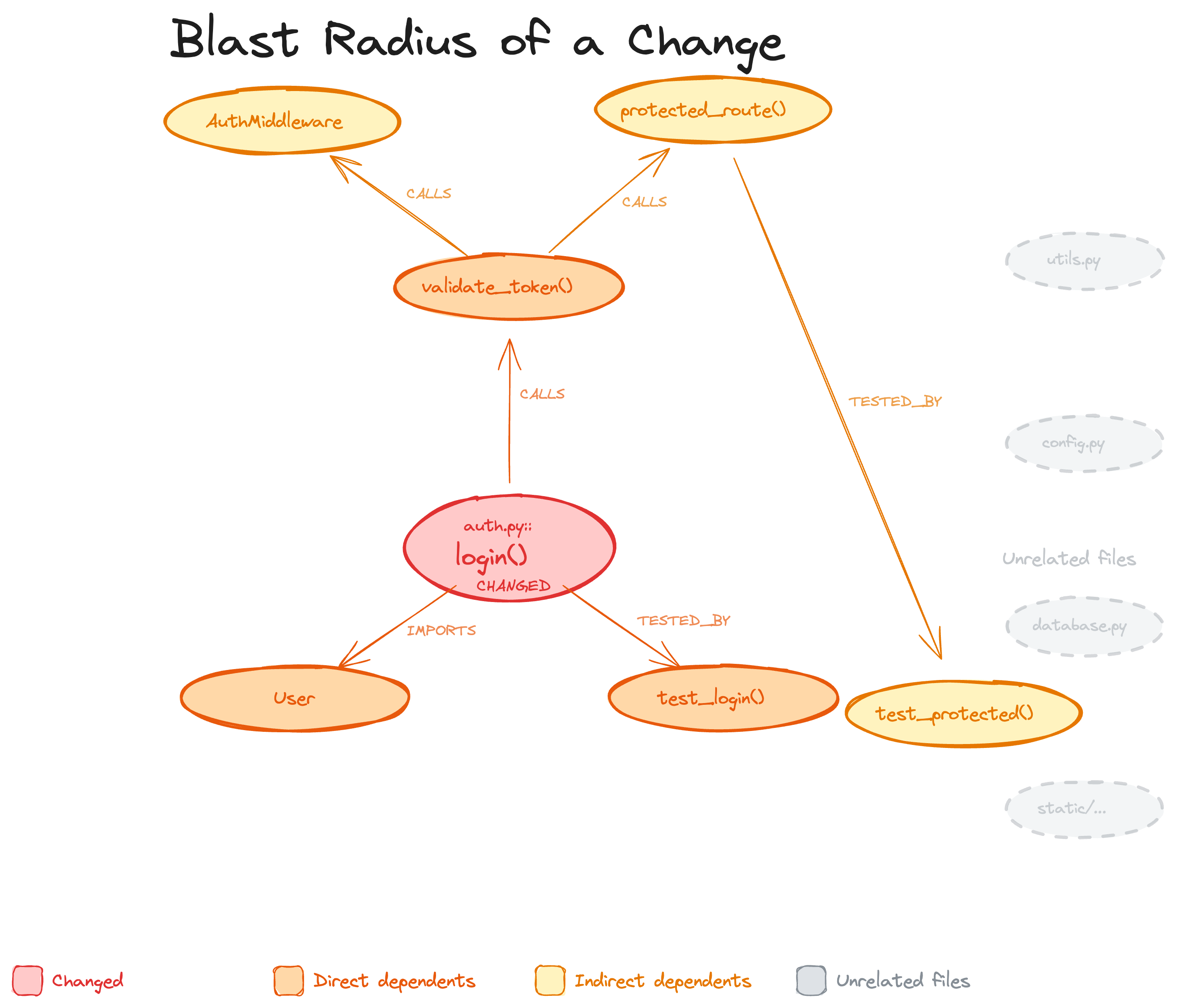
When a file changes, the graph traces every caller, dependent and test that could be affected. The assistant reads those files instead of scanning the whole project.
Incremental updates
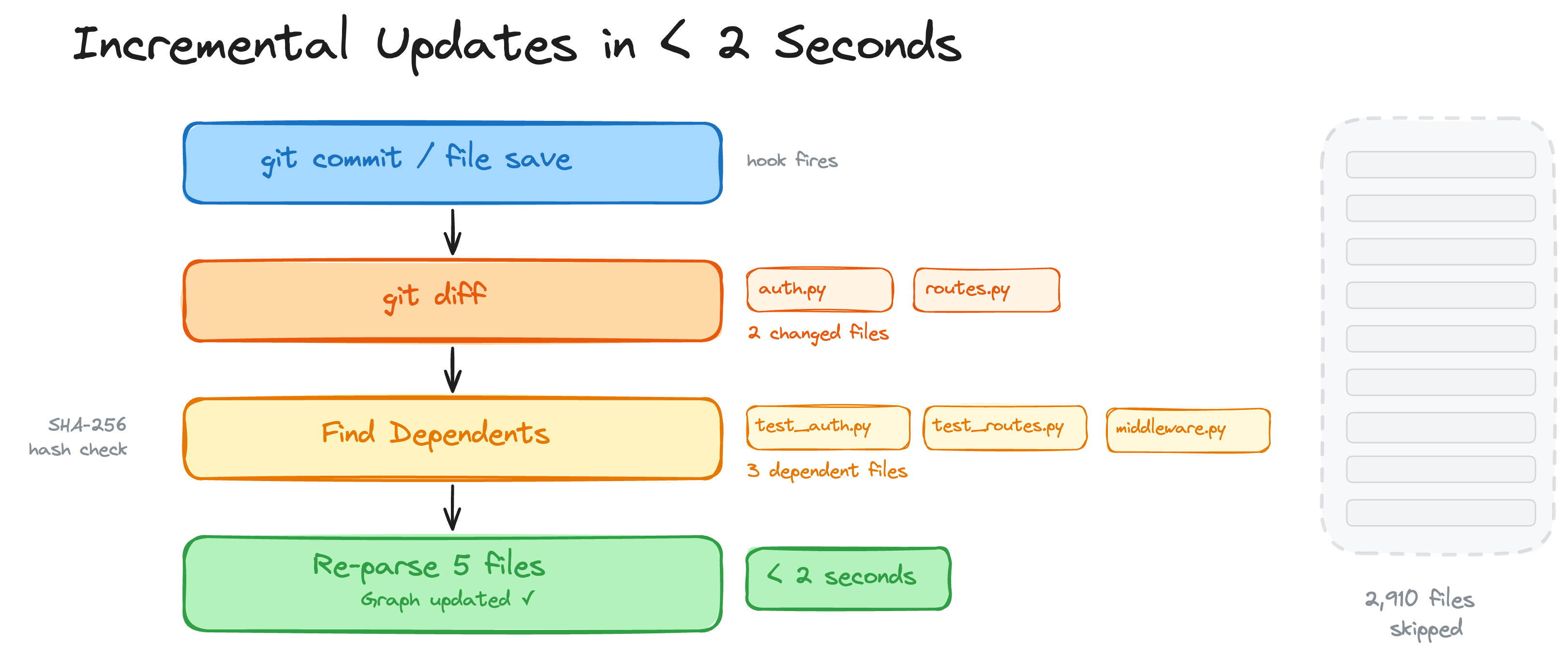
Hooks, the pre-commit hook and watch mode trigger incremental updates. The update diffs changed files, finds their dependents through the graph's import and call edges, and re-parses only the files whose SHA-256 hash changed. On a ~3,000-file project (django) a two-file edit re-indexes in about 2.5 seconds on the path the hooks use, of which ~1.4 s is process start-up; a no-op update costs only that start-up. See Incremental update latency.
Whole codebase or targeted answer?
Instead of feeding a whole corpus to the model, the graph returns a slice shaped to the question. In the 2026-08-02 capture of this repository at 84bde354, 208,821 source tokens became ~3,190 tokens per question. The repository has grown a lot since that snapshot, so both numbers are larger today.

Language coverage and notebooks

The parser extracts functions, classes, imports, call sites, inheritance and tests, using Tree-sitter where a grammar exists and targeted fallbacks elsewhere. Supported: Python, JavaScript/TypeScript/TSX, Go, Rust, Java, C/C++, C#, VB.NET, Ruby, Kotlin, Swift, PHP, Scala, Solidity, Dart, R, Perl, Lua/Luau, Objective-C, shell scripts, Elixir, Zig, PowerShell, Julia, ReScript, GDScript, Nix, Verilog/SystemVerilog, SQL, Terraform/OpenTofu (.tf; other .hcl files become file nodes only), Ansible YAML (playbooks, roles, tasks), Spring Boot application config (application.properties, application.yml, application.yaml and their application-<profile> variants; key names and value types only, never values), Vue/Svelte SFCs, Astro files (parsed with the TypeScript grammar), Jupyter and Databricks notebooks (.ipynb), a
📈 近 7 天 Star 趋势
🏆 排名变化趋势
📋 历史上榜记录
| 日期 | 榜单 | 排名 | 周期新增 | 总 STAR |
|---|