📄 仓库 README
在 GitHub 查看 ↗Treg (OpenRouter for Tools)
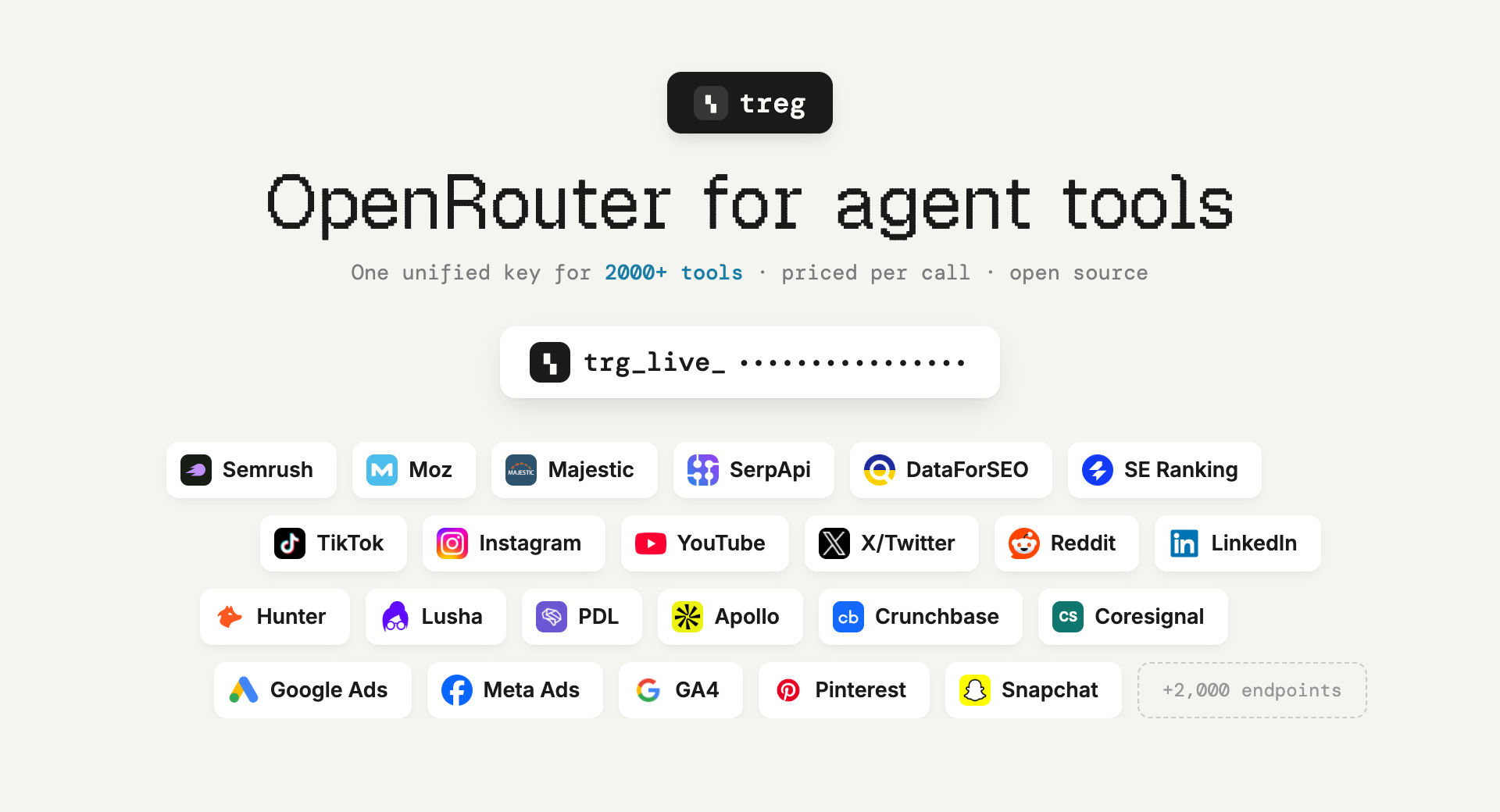
OpenRouter, but for agent tools instead of models. Point an agent at one base URL with one token and it can do the job: a curated catalog of thousands of endpoints across many providers — SEO and backlinks, social and trends, people and company enrichment, ads, scraping, image and video generation — priced per call, from a cent, with no provider signup. Plus your own team's keys, skills and CLIs, callable by every teammate's agent without the credential ever leaving the server.
Ask for the task, not the tool. You do not need to know which vendor sells backlink data, or to hold an account with them. Search for what you want to do, read the price, call it.
Built for the Superdesign team, live at treg.to — anyone can self-host.
Why it exists
The tools an agent needs for real work sit behind subscriptions nobody buys for a single run — Semrush $139/mo, Moz $99/mo, Crunchbase $99/mo, Apollo $59/seat — behind signup walls, or behind no public API at all (invite-only, partner-only, app-review-only). treg carries those accounts and bills fractions of a cent per call.
Two kinds of tool, one token
- The catalog — external endpoints treg can serve with its own key or through a verified public route that needs no provider key. Own-key calls use the team's prepaid balance; anonymous calls are free. No account with the provider is needed. New verified accounts receive $1.00 free once, when they create an eligible team.
- Your own tools — anything a teammate registered: a paid API account, an OAuth connection, a
vendor CLI, a
SKILL.md. Your own key always wins over treg's, and those calls are never metered.
The vocabulary for the second half:
- tool = something the registry calls for you with the org's credential. Two kinds:
- endpoint — an upstream
base_url+ credential bindings (each binding injects one secret into the request; a request can carry several, e.g. an OAuth bearer and adeveloper-tokenheader). - CLI — a vendor binary (
stripe,gh,vercel, ...) run with the credential injected. - skill / bundle = a recipe (
SKILL.md) + its secrets + its tool(s), registered together.
The one rule: the proxy relays, never models the upstream, and injects auth server-side — so it survives upstream API changes and callers never hold keys.
Part 1 · Using the registry
Visit treg.to (hosted on Render) — the dashboard, sign-in, and every URL below live there.
Quickstart
Same flow as the dashboard's Getting started guide:
# 1. install the CLI — also points it at the registry
curl -fsSL https://treg.to/install.sh | sh

# 2. sign in (GitHub default · --email for a one-time code · --token for agents/CI)
treg login

# 3. do something useful immediately — no key, nothing registered
treg catalog search "backlinks for a domain"     # find a tool by what it DOES
treg call tikhub.tiktok.user.profile --query uniqueId=tiktok
treg balance                                     # exactly what that cost

# (or `treg onboard` for the guided walkthrough)
Fish Audio provides S2.1 Pro speech, public-voice discovery, and private voice cloning.
Speech is binary stdout, so redirect it to a file. A discovered voice's _id or a team voice id is
the TTS reference_id; voices created on treg's Fish account are durable team resources:
treg call fishaudio.tts.s2-1-pro --method POST --header model=s2.1-pro \
  --data '{"text":"Hello from treg","format":"mp3"}' > speech.mp3
treg call fishaudio.voices.discover --query self=false --query licensed=false --query language=en
treg resources list --provider fishaudio --kind voice
With your own Fish key, requests remain an unrestricted, unmetered upstream relay and Fish owns the account boundary.
Catalog tool inputs are described by treg catalog get <id>. Tools marked strict_query reject undeclared or repeated query parameters, unsupported values and request bodies.
Your token identifies you on every call (X-Treg-Token header) and is the same for all tools.
Discover what your team has shared: treg tool ls · check credential health: treg health.
Or install it as a Claude Code plugin
/plugin marketplace add superdesigndev/treg
/plugin install treg@treg
Installs the treg skill and treg's tools with no token and no configuration. Run /mcp, pick
treg and sign in; the tools appear after it. Other agents: npx skills add superdesigndev/treg -s treg
(or see Workflow skills for the rest).
See docs/CLAUDE-PLUGIN.md. MiniMax Code / MiniMax Agent users: the same
skill ships via the MiniMax Plugin Marketplace (docs/MINIMAX-PLUGIN.md).
Workflow skills
Ready-made recipes your agent runs end to end, every call through treg:
| Skill | What your agent can do |
|---|---|
treg |
Find and call any tool in the catalog, plus your own tools |
web-access |
Read the live web without local scrapers: free search and page reads first, then the right platform job for social, stores, reviews, maps and papers, with treg falling back to the next vendor when one fails |
lead-signals |
Find in-market buyers from public signals (complaints, job changes, hiring, funding, tool adoption) and monitor a topic, competitor or account list for them (treg.to/leads-signals) |
recruit |
Turn a LinkedIn job post into a ranked shortlist: criteria from the post, people search, filters with reasons, one line on why each fits, cited evidence (posts, GitHub, talks, tenure, job change) under a per-candidate spend cap, then a checked personal email and phone, with a run file of counts, evidence and the vendor trail per candidate |
make-ugc |
Make AI UGC videos: trending hooks, a presenter, talking-head clips, captions (treg.to/ugc) |
jev-memory |
Give Claude Code a memory: a Claude Code mod where Jev judges each prompt after the turn and keeps your lasting preferences, installed ready-made or built from one prompt (the mod) |
install.sh installs all of them for you except jev-memory, which is opt-in. In Claude Code each one is
also its own plugin in treg's marketplace: /plugin install recruit@treg, or pick them from /plugin. To add
them to an existing agent instead (skills.sh CLI):
npx skills add superdesigndev/treg                        # every public skill
npx skills add superdesigndev/treg --skill lead-signals   # just one
treg skill bootstrap                                      # same set, with the treg CLI you already have
The workflow skills run on treg, so set it up first (the Quickstart above, or point your agent at treg.to/llms.txt).
Claude.ai connector
The Claude Connectors Directory surface is https://treg.to/mcp/v2/. It exposes only curated
catalog endpoints, without image, video or audio generation, and separates read calls from write
calls so Claude receives accurate safety signals. The existing /mcp/ surface remains available for catalog endpoints, team-owned tools,
and imported skills. See the MCP and OAuth architecture
for the boundary and implementation, and the
submission runbook for release gates.
Call a tool you don't have a key for
The catalog is grouped by what endpoints do: keyword and rank tracking, backlinks and authority, AI visibility, trending and discovery, publishing to socials, people and company enrichment, ads management and creative, measurement.
treg catalog                                    # every platform, busiest first
treg catalog search "find a work email"         # by the job, not the vendor
treg catalog search --new                       # tools added in the last 30 days, newest first
treg catalog get hunter.people.email.find       # params, PRICE, example response
treg call hunter.people.email.find --query domain=reddit.com --query full_name="Alexis Ohanian"
How a catalogued call is served — the credential ladder, in order:
- your team registered its own tool for that provider → that tool, that key;
- your team stored a secret for the provider → injected through a virtual tool;
- neither, and the endpoint has a verified public route → no provider key, free;
- otherwise → treg's own key, billed to the team's prepaid balance.
The anonymous price assumes the caller does not send a provider credential header. The faithful
relay preserves caller headers, so a caller-supplied provider key can use that key's credits.
Your own credential always beats treg's, so connecting a key you already pay for makes those calls
free of the balance rather than duplicating them. An endpoint treg has no published price for is
refused, not served free — you are told to connect your own key instead. Where several providers
serve one capability, treg catalog search shows them side by side with prices; choosing is
yours — treg does not silently pick or fail over between providers for you. (When treg's own
account for a provider is out it may serve the same endpoint through a treg-owned relay account,
disclosed on the response; a team can opt out.) The exception you opt into: treg.<capability> routed endpoints, where treg picks the provider for you and names it. For common jobs (scraping a page, web search, Google results, finding an email) start with the routed endpoint, such as treg.web.extract or treg.web.search, rather than a provider you remember by name. On treg.people.email.find and treg.people.phone.find, X-Treg-Route-Verify: true also checks the found address or number in the same call, as its own charge, and says what the check found.
```bash treg balance # credit left, calls in flight, recent spend treg topup # a
📈 近 7 天 Star 趋势
🏆 排名变化趋势
📋 历史上榜记录
| 日期 | 榜单 | 排名 | 周期新增 | 总 STAR |
|---|