📄 仓库 README
在 GitHub 查看 ↗π RuView
 Start here |
 Hardware |
 Models |
 AI toolkit |
 Smart home |
 Cognitum Seed |
See through walls with WiFi
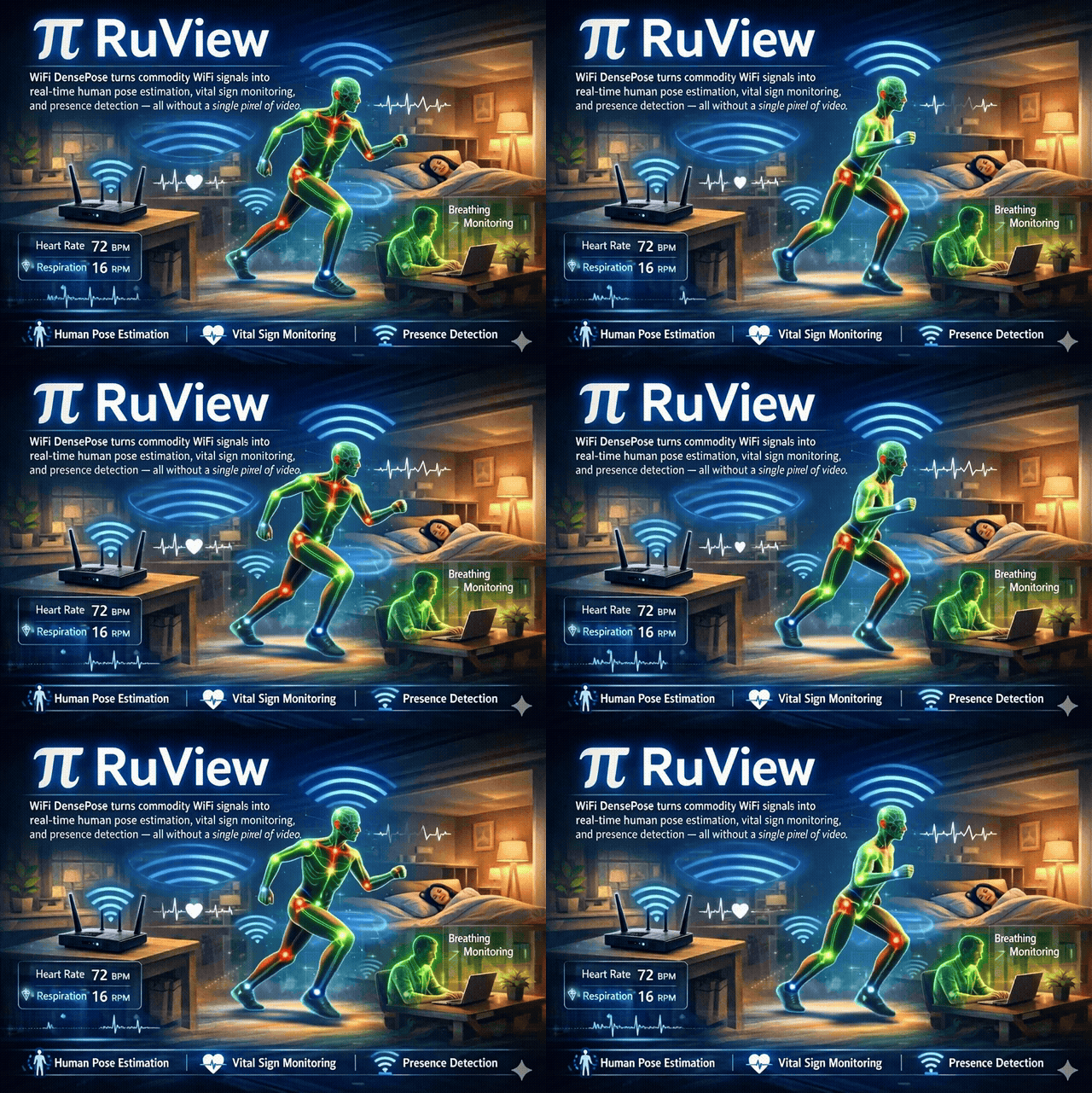
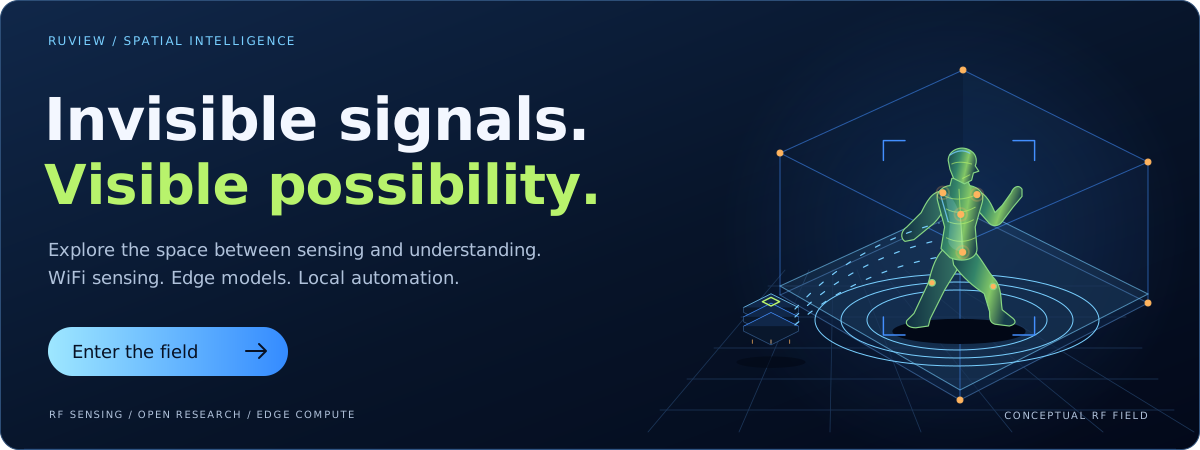
Turn ordinary WiFi into a spatial intelligence / sensing system. Detect people, measure breathing and heart rate, track movement, and monitor rooms — through walls, in the dark, with no cameras or wearables. Just physics.
Works natively with the four major smart-home ecosystems: Home Assistant via the HA-DISCO MQTT publisher, Apple Home & HomePod as a discoverable HAP-1.1 bridge, Google Home + Amazon Alexa via the same HA bridge or a Matter endpoint. Siri, Google Assistant, and Alexa can voice presence and vitals by room with zero custom skills.





Drop into any Home Assistant install with one
--mqttflag. Or pair into Apple Home / Google Home / Alexa / SmartThings as a Matter Bridge. Ships 21 entities per node (11 raw signals + 10 inferred semantic states: someone-sleeping, possible-distress, room-active, elderly-inactivity-anomaly, meeting-in-progress, bathroom-occupied, fall-risk-elevated, bed-exit, no-movement, multi-room-transition) plus 3 starter HA Blueprints. Seedocs/integrations/home-assistant.md· ADR-115.
π RuView is a WiFi sensing platform that turns radio signals into spatial intelligence.
Every WiFi router already fills your space with radio waves. When people move, breathe, or even sit still, they disturb those waves in measurable ways. RuView captures these disturbances using Channel State Information (CSI) from low-cost ESP32 sensors and turns them into actionable data: who's there, what they're doing, and whether they're okay.

What it senses: - Presence and occupancy — detect people through walls, count them, track entries and exits - Vital signs — breathing rate and heart rate, contactless, while sleeping or sitting - Activity recognition — walking, sitting, gestures, falls — from temporal CSI patterns - Environment mapping — RF fingerprinting identifies rooms, detects moved furniture, spots new objects - Sleep quality — overnight monitoring with sleep stage classification and apnea screening
Also included:
- Camera-free pose — estimate 17 body keypoints from WiFi CSI
- Built-in model workflow — record CSI, train models, load RVF files, and switch LoRA profiles
- Local automation — HOMECORE provides state, history, automations, signed Wasm plugins, voice hooks, and HomeKit support
- Unified RF world model — combine WiFi CSI, radar, UWB, and cellular sensing in one privacy-bounded scene model; accuracy is still synthetic until real-data validation
- Governed evidence — attach privacy policy, uncertainty, provenance, and witness records to sensing events
- RuView MetaHarness — use an AI operator to onboard, calibrate, train, verify, and check sensing claims
 Presence and motion |
 Breathing and vital signals |
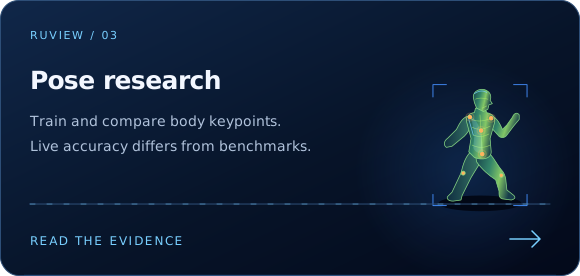 Pose research and limitations |
 Edge sensor mesh |
 Local automation |
 Guided AI operator |
RuView MetaHarness — guided operation for humans and AI agents
The RuView-specific metaharness we created is published as [`@ruvnet/ruview`](https://github.com/ruvnet/RuView/blob/HEAD/harness/ruview/README.md). It provides: - source-cited guidance; - device access for CSI nodes, radar and LiDAR; - firmware flashing with boot evidence; - one MCP server, usable over stdio or HTTP for ChatGPT, with a live console widget; - a Claude Code mod; - guarded Claude Code/Codex agents; - deterministic verification; - an honesty check for accuracy claims. Companion packages: [`homecore`](https://github.com/ruvnet/RuView/blob/HEAD/harness/homecore/README.md) (Homecore developer metaharness) and [`@ruvnet/ruview-kernel`](https://github.com/ruvnet/RuView/blob/HEAD/harness/ruview-kernel/README.md) (the vitals pipeline as WASM). ```bash # Check the local setup and get source-cited guidance npx @ruvnet/ruview@0.9.1 doctor npx @ruvnet/ruview@0.9.1 guidance --topic sensing --query "model loading" # Hardware: what is plugged in, live CSI from your nodes, a 60 GHz radar kit npx @ruvnet/ruview@0.9.1 devices npx @ruvnet/ruview@0.📈 近 7 天 Star 趋势
🏆 排名变化趋势
📋 历史上榜记录
| 日期 | 榜单 | 排名 | 周期新增 | 总 STAR |
|---|