📄 仓库 README
在 GitHub 查看 ↗ # **Write. Search. Fork. The State Store for AI Agents.**










🌿 FORK/MERGE sandboxes for safe agent exploration
🔍 Vector + full-text + scalar in one SQL query
🐬 Full ACID, MySQL protocol, works with LangChain/LlamaIndex/Dify **English** | [中文版](https://github.com/oceanbase/seekdb/blob/HEAD/README_CN.md) | [日本語](https://github.com/oceanbase/seekdb/blob/HEAD/README_JP.md) [30-Second Try](#30-second-try) · [Quick Start](#quick-start) · [Embedded SDKs](#embedded-sdks) · [Why seekdb](#why-seekdb-for-agents) · [Ecosystem](#ecosystem--integrations) · [Contributing](#development) If you find seekdb useful, consider giving it a star — it helps others discover the project. ---
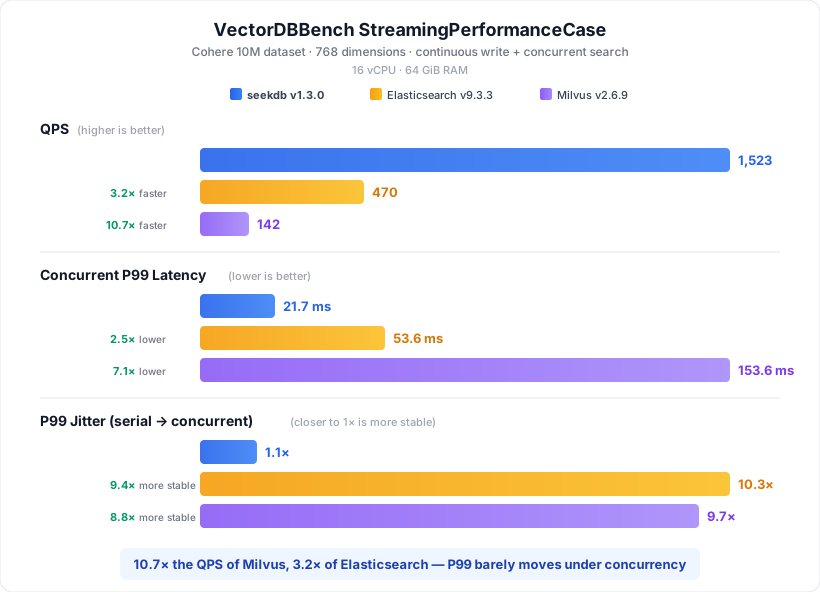
⚡ Performance at a Glance
⏱️ 30-Second Try

pip install -U pyseekdb # pyseekdb is the Python SDK for seekdb
No manual server deployment, schema definition, or embedding setup for this Python demo. Run a local database with Python, JavaScript, or Go →
✨ Why seekdb for Agents?
🔥 Streaming Write + Concurrent Search, Without the P99 Spike
Agent workloads are continuous write + millisecond-later read. seekdb's async index pipeline (Change Stream) decouples DML from index build, and its two-level HNSW (incremental + snapshot) makes newly-written vectors immediately searchable.
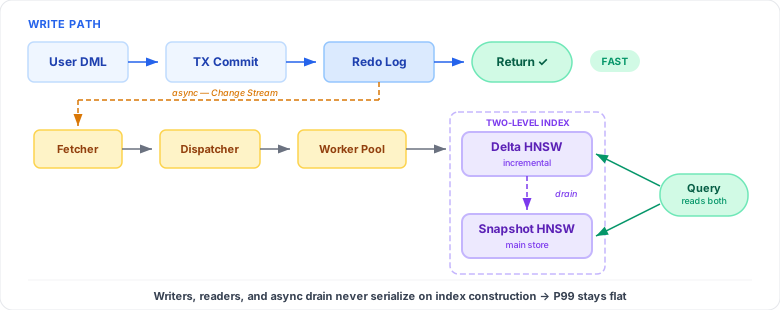
The write path commits and returns without waiting on index construction. The Change Stream pipeline consumes the redo log asynchronously and updates the delta HNSW. Queries hit both delta and snapshot indexes with fine-grained read locks — this is why P99 stays flat under concurrency.
The result: 1,523 QPS with 21.7 ms concurrent P99 — 10.7× the QPS of Milvus, and P99 jitter of just 1.1× when concurrency rises (vs ~10× for ES / Milvus on the same workload).
Source: src/observer/change_stream/ · src/observer/vector_index/
🌿 Copy-on-Write Sandboxes for Agent Exploration
FORK DATABASE snapshots an entire database in seconds — no data copy.
Agents experiment freely (write, query, even break tables); then MERGE TABLE
commits the work back, or DROP DATABASE discards it. Kernel-level COW,
not application-layer save/restore.
-- Snapshot in seconds, no data copy
FORK DATABASE agent_state TO agent_sandbox_42;

-- Agent reads/writes freely on the sandbox...
USE agent_sandbox_42;
INSERT INTO memory (session_id, embedding, content) VALUES (...);

-- Accept the work back to mainline (strategies: FAIL / THEIRS / OURS)
MERGE TABLE agent_sandbox_42.memory INTO agent_state.memory STRATEGY THEIRS;
-- ...or throw it away:
DROP DATABASE agent_sandbox_42;
Source: tools/deploy/mysql_test/test_suite/fork_table/
🔍 Hybrid Search in a Single SQL
Vector + full-text + scalar filter pushed into one execution plan. No N+1 client-side merging, no glue code to combine results.
SELECT id, title, l2_distance(emb, '[0.12,0.34,...]') AS dist
FROM docs
WHERE MATCH(content) AGAINST('quarterly report')
  AND author_id = 42
  AND created_at > '2026-01-01'
ORDER BY dist APPROXIMATE LIMIT 10;
🐬 MySQL-Compatible, ACID, Embeddable
Built on the proven OceanBase SQL engine. Works as an embedded library, a single-node server, or in the OceanBase distributed cluster. Full ACID, real-time writes, and the entire MySQL ecosystem out of the box.
🎬 Quick Start
Embedded use
Use a local seekdb database from Python, Node.js, or Go without deploying a database service yourself. Data is stored in a local directory and remains available when you reopen it.
🐍 Python
Use [pylibseekdb](https://pypi.org/project/pylibseekdb/) to start a local seekdb database, then execute SQL with PyMySQL. Requires Python 3.11 or newer.python3 -m pip install -U pylibseekdb pymysql
from contextlib import closing

import pylibseekdb
import pymysql

with closing(pylibseekdb.open("./seekdb.db")) as db:
    options = db.connection_options()
    with pymysql.connect(
        database="test",
        autocommit=True,
        cursorclass=pymysql.cursors.DictCursor,
        **options,
    ) as connection:
        with connection.cursor() as cursor:
            cursor.execute("SELECT 1 AS value")
            print(cursor.fetchall())
python3 example.py
🟨 JavaScript / TypeScript (Node.js)
Use [@oceanbase/seekdb-node](https://www.npmjs.com/package/@oceanbase/seekdb-node) to start a local seekdb database, then execute SQL with `mysql2`. Requires Node.js 22 or newer and supports both JavaScript and TypeScript.npm install @oceanbase/seekdb-node mysql2
import { seekdb } from "@oceanbase/seekdb-node";
import mysql from "mysql2/promise";

const db = await seekdb.open("./seekdb.db");
let connection;
try {
  const endpoint = db.connectionOptions();
  const location = endpoint.transport === "tcp"
    ? { host: endpoint.host, port: endpoint.port }
    : { socketPath: endpoint.transport === "unix_socket"
        ? endpoint.unixSocket : endpoint.namedPipe };
  connection = await mysql.createConnection({
    ...location,
    user: endpoint.user,
    password: "",
    database: "test",
  });
  const [rows] = await connection.query("SELECT 1 AS value");
  console.log(rows);
} finally {
  try {
    if (connection) await connection.end();
  } finally {
    db.close();
  }
}
node example.mjs
🐹 Go
Use [seekdb-go](https://github.com/oceanbase/seekdb-go) to start a local seekdb database, then execute SQL with `go-sql-driver/mysql`. This example requires Go 1.24 or newer, `CGO_ENABLED=1`, and a C compiler.mkdir seekdb-go-example
cd seekdb-go-example
go mod init example.com/seekdb-demo
package main

import (
    "database/sql"
    "fmt"
    "log"
    "net"

    "github.com/go-sql-driver/mysql"
    seekdb "github.com/oceanbase/seekdb-go"
)

func main() {
    if err := run(); err != nil {
        log.Fatal(err)
    }
}

func run() error {
    db, err := seekdb.Open("./seekdb.db")
    if err != nil {
        return err
    }
    defer db.Close()

    endpoint, err := db.ConnectionOptions()
    if err != nil {
        return err
    }
    cfg := mysql.NewConfig()
    cfg.User, cfg.DBName = endpoint.User, "test"
    switch endpoint.Transport {
    case "unix_socket":
        cfg.Net, cfg.Addr = "unix", endpoint.UnixSocket
    case "tcp":
        cfg.Net, cfg.Addr = "tcp", net.JoinHostPort(endpoint.Host, fmt.Sprint(endpoint.Port))
    default:
        return fmt.Errorf("unsupported transport %q", endpoint.Transport)
    }
    connection, err := sql.Open("mysql", cfg.FormatDSN())
    if err != nil {
        return err
    }
    defer connection.Close()

    var value int
    if err := connection.QueryRow("SELECT 1 AS value").Scan(&value); err != nil {
        return err
    }
    fmt.Println(value)
    return nil
}
go run -mod=mod .
These examples store data in ./seekdb.db and can be rerun. The path is a database directory. Initializing a new directory can take longer than subsequent opens.
Server deployments
☁️ Cloud (Zero Install)
One curl, a running database — no signup, no credit card.curl -X POST https://d0.seekdb.ai/api/v1/instances
🐳 Docker (Quick Testing)
docker run -d \
  --name seekdb \
  -p 2881:2881 \
  -p 2886:2886 \
  -v ./data:/var/lib/oceanbase \
  oceanbase/seekdb:latest
📦 Binary (Standalone)
# Linux (one-line install, may need sudo)
curl -fsSL https://obportal.s3.ap-southeast-1.amazonaws.com/download-center/opensource/seekdb/seekdb_install.sh | bash

# macOS (Homebrew)
brew tap oceanbase/seekdb
brew install seekdb
📝 More Examples
Start with the runnable Python, JavaScript, and Go examples above. The following application pattern assumes an existing agent implementation.
🤖 Agent Memory Pattern (continuous write + immediate retrieval)
The canonical agent loop: write an observation, retrieve relevant context milliseconds later, repeat. seekdb's async index pipeline keeps both sides fast under sustained concurrency.import pyseekdb
client = pyseekdb.Client(path="./agent_state.db")
memory = client.get_or_create_collection(name="episodic")
for step in agent.run():
# Persist the observation
memory.upsert(ids=[step.id], documents=[step.observation])
# Retrieve relevant context — milliseconds after the write,
# served by the incremental HNSW (no waiting on a background rebuild)
relevant = memory.query(query_texts=step.next_query, n_results=5)
agent.act(relevant)
🗄️ SQL — Schema + Hybrid Search
-- Table with vector column, full-text index, and HNSW vector index
CREATE TABLE articles (
  id        INT PRIMARY KEY,
  title     TEXT,
  content   TEXT,
  embedding VECTOR(384),
  FULLTEXT INDEX idx_fts (content) WITH PARSER ik,
  VECTOR   INDEX idx_vec (embedding) WITH (DISTANCE=l2, TYPE=hnsw, LIB=vsag)
) ORGANIZATION = HEAP;

-- Hybrid search: vector similarity + full-text match in one query
SELECT id, title,
       l2_distance(embedding, '[0.12, 0.34, ...]') AS dist
FROM articles
WHERE MATCH(content) AGAINST('quarterly report')
ORDER BY dist APPROXIMATE
LIMIT 10;
📚 Use Cases
🎯 Agentic AI — Memory, Sandbox & State
Agents need a state store that handles continuous memory writes, millisecond-later retrieval, branching for exploration, and rollback when things go wrong. seekdb is built for exactly this: - **Streaming-friendly storage** — write a memory, query it in the next ms - **COW sandboxes** — `FORK DATABASE` for safe experimentation, `MERGE` to accept, `DROP` to roll back - **Hybrid retrieval** — vector + full-text + relational in one SQL - **MySQL protocol** — works with LangChain, LlamaIndex, Dify out of the box Personal assistants · Enterprise automation · Vertical agents · Agent platforms🧩 Other Use Cases
seekdb's hybrid retrieval + multi-model engine also fits classic AI workloads: - **📖 RAG & Knowledge Retrieval** — vector + full-text + scalar filters with multi-level access control. *Enterprise QA, customer support, industry insights, personal knowledge bases.* - **🔍 Semantic Search** — embedding-based search across text, images, and other modalities. *Product search, text-to-image, image-to-product.* - **💻 AI-Assisted Coding** — semantic code search, multi-project isolation, time-travel queries for IDE plugins and code agents. *Local IDEs, web IDEs, design-to-web.* - **⬆️ Enterprise Application Intelligence** — MySQL-compatible AI layer for legacy systems, with row/column hybrid storage. *Document intelligence, business insights, finance systems.* - **📱 On-Device & Edge AI** — embedded / micro-server modes for resource-constrained devices. *In-vehicle systems, AI education, companion robots, healthcare devices.*🌟 Ecosystem & Integrations






🌐 Next Steps & Community
- 📖 Read the docs → — Quickstart, API reference, integration guides
- 📝 Launch blog → — The architecture behind 10.7× the QPS of Milvus
- 🐛 Open an issue → — Report bugs, request features
- 🤝 Contribute → — Help build the agent-era state store



🛠️ Development
Build from Source
Before building, please install the required toolchain and dependencies for your operating system. See Install Toolchain for detailed instructions.
# Clone the repository
git clone https://github.com/oceanbase/seekdb.git
cd seekdb
./build.py init
./build.py build seekdb
mkdir -p ~/seekdb/bin
cp build/bin/src/observer/seekdb ~/seekdb/bin
cd ~/seekdb
./bin/seekdb
In this example, the working directory is $HOME/seekdb, please use a fresh directory for testing. Please see the Developer Guide for detailed instructions.
Contributing
We welcome contributions! See our Contributing Guide to get started.
📈 Star History
If seekdb is useful to you, a star helps others find it. ⭐
📄 License
seekdb is built by the OceanBase team — the same database engine running in production at Alipay, Taobao, DiDi, Xiaomi, and more. Fully open-source under the Apache License, Version 2.0.
📈 近 7 天 Star 趋势
🏆 排名变化趋势
📋 历史上榜记录
| 日期 | 榜单 | 排名 | 周期新增 | 总 STAR |
|---|