📄 仓库 README
在 GitHub 查看 ↗
Your Data. Your Model. Your Hardware.
Turn clinical text into structured, de-identified insight on hardware you control.
OpenMed's core local runtime performs extraction and de-identification after required model artifacts are available. Model downloads, remote-provider adapters, telemetry-enabled paths, and user-configured integrations may use a network; review each model and dataset's terms.
PyPI package · Python 3.10+ · Model catalog · Research paper · Apache-2.0 SDK source
OpenMedKit · Apple Silicon / MLX · Android / ONNX Runtime Mobile · Browser / Transformers.js · Documentation
2,266 manifest entries · 35 model-backed PII languages · Apache-2.0 SDK
English · 简体中文 · Español · Français · Deutsch · Italiano · Português · Nederlands · العربية · हिन्दी · తెలుగు · 日本語 · Türkçe · فارسی · Kiswahili
See it in action
This iPhone example uses OpenMed's local runtime after the required model artifacts are available:
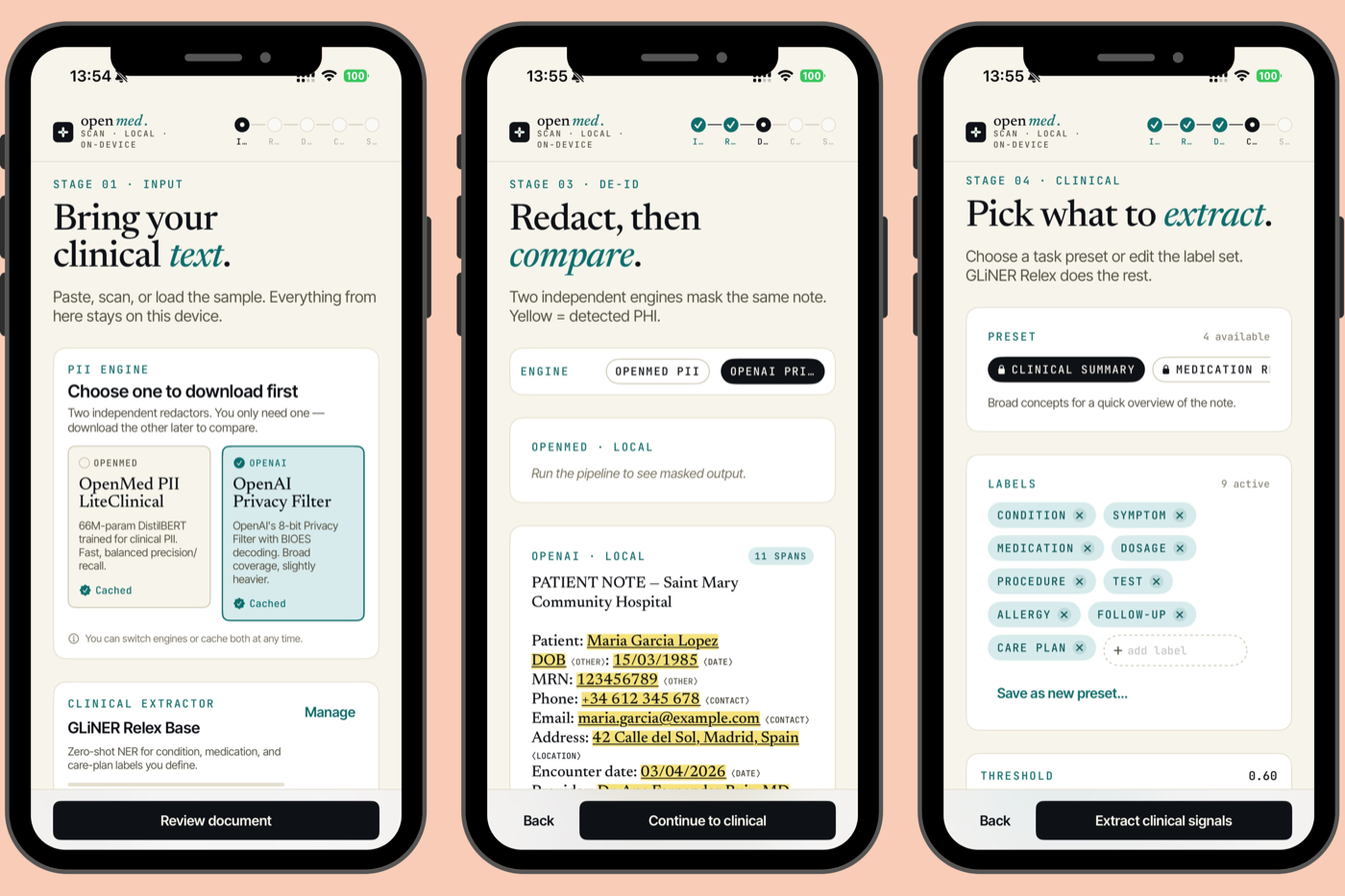
On iPhone via OpenMedKit: scan a clinical note, de-identify it, and extract clinical signals with Apple MLX processing locally in this configuration.
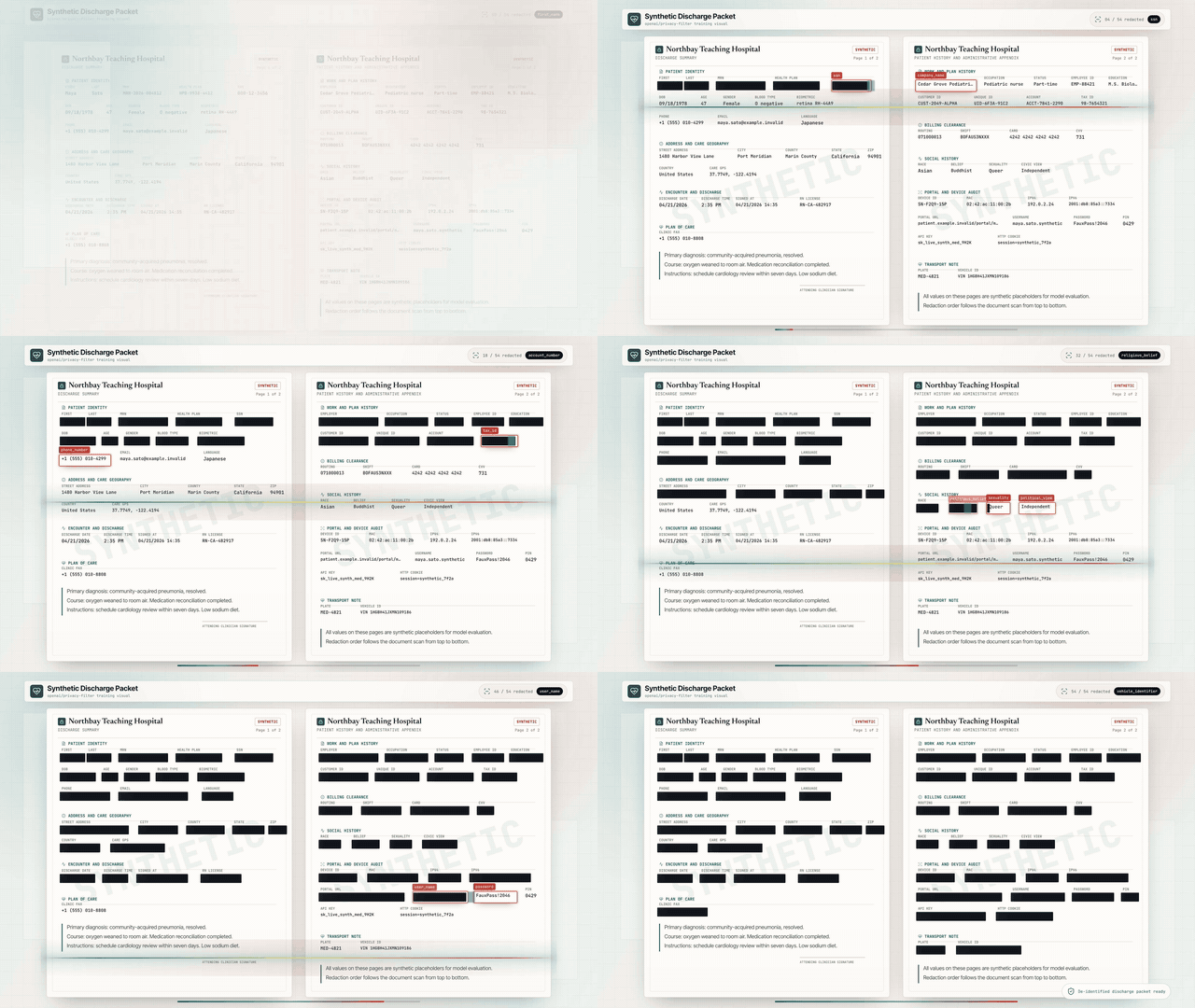
Real-time PII de-identification: in this configured local workflow, the Nemotron Privacy Filter redacts names, addresses, IDs, and billing data from a synthetic clinical discharge packet. (All values shown are synthetic.)
30-second example
from openmed import analyze_text

result = analyze_text(
    "Patient started on imatinib for chronic myeloid leukemia.",
    model_name="disease_detection_superclinical",
)

for entity in result.entities:
    print(f"{entity.label:<12} {entity.text:<28} {entity.confidence:.2f}")
# DISEASE      chronic myeloid leukemia     0.98
# DRUG         imatinib                     0.95
A clinical NER model using the local runtime after its required artifacts are available.
Clinical brief in 30 seconds
From a source checkout, run the CPU-only synthetic contract demonstration:
python examples/v30_clinical_brief.py
# Optional: --model mlx, with the pinned model already cached on Apple silicon.
It de-identifies an embedded note, extracts and grounds a finding, then prints a cited brief, verdicts and a value-free review packet. NER/NLI providers are explicit synthetic test doubles, not trained-model or clinical validation. No external note input is accepted. The MLX option may refuse unsupported output; it never bypasses the guards. See the brief guide and demo script for the boundaries and local setup.
Building with an agent?
Start with the consumer agent-usage guide, or load the curated llms.txt documentation index. For callable local interfaces, use the MCP server, the typed tool registry, or the command-line interface. Ready-made cross-tool procedures live in the repository skills catalog.
Why OpenMed?
| Deployment consideration | OpenMed SDK boundary |
|---|---|
| Core runtime | Processes locally after required artifacts are available |
| Optional network paths | Downloads, remote adapters, telemetry-enabled paths, and user integrations may use a network |
| Validation | Deployment owners validate model and dataset terms, privacy behavior, and clinical fitness |
| Interfaces | Python, Swift, Android, browser, and service surfaces where supported |
- Curated model catalog: validate each model, license, and dataset for your use case.
- Safe Harbor-aligned configuration: can target the 18 identifier categories; expert deployment review remains required, and use of the SDK does not itself establish HIPAA compliance.
- Supported execution paths: CPU, CUDA, MLX, mobile, service, and browser adapters vary by environment and artifact.
- Deployment interfaces: Python, containers, services, and batch workflows require configuration and validation.
- SDK source: released under the Apache-2.0 License; model and dataset terms vary.
On-device on Apple: Swift, MLX & iOS
On supported Apple hardware, OpenMed can use MLX and OpenMedKit for local processing after required artifacts are available. Model acquisition and any user-configured remote integrations remain separate network boundaries.
// Add OpenMedKit to your app
dependencies: [
    .package(url: "https://github.com/maziyarpanahi/openmed.git", from: "3.1.0"),
]
Expected result: Swift Package Manager resolves OpenMedKit and makes
import OpenMedKit available to your app target.
- MLX runtime for PII token classification, the Privacy Filter family, experimental GLiNER-family zero-shot tasks, and Python MLX-LM text generation with Laneformer; includes a CoreML fallback path for supported token-classification artifacts.
- Portable model naming where supported: an MLX model name can fall back to a matching PyTorch checkpoint when that mapping and artifact are available on non-Apple hardware.
- Python on Apple Silicon too:
pip install --upgrade "openmed[mlx]".
Guides: MLX backend · OpenMedKit (Swift) · CoreML export
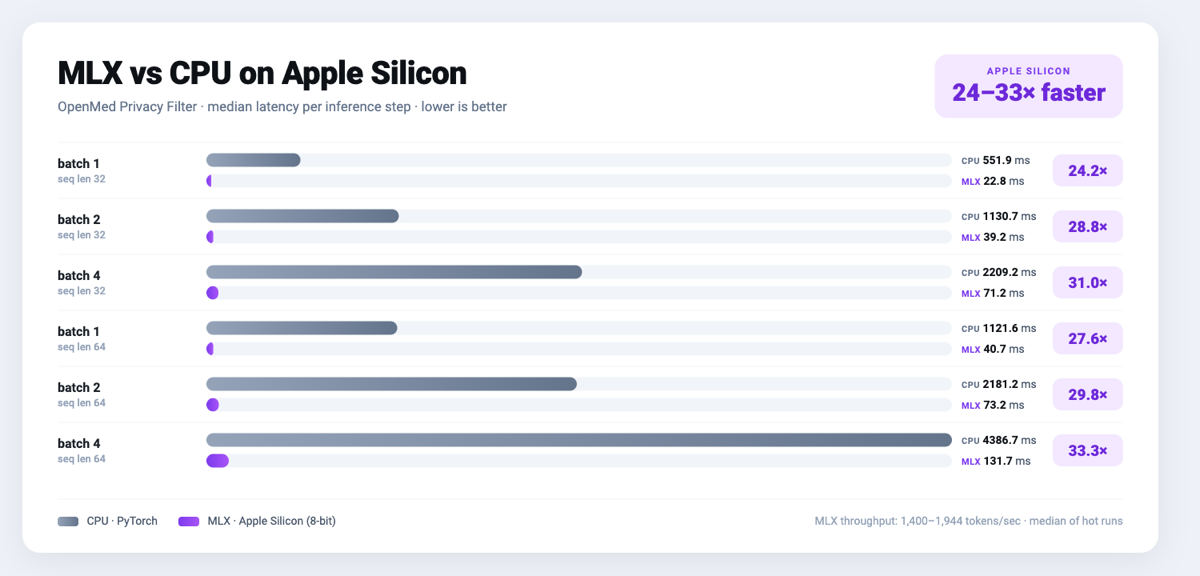
MLX on Apple Silicon: 24–33× faster than CPU PyTorch for the Privacy Filter: median latency per inference step, lower is better.
On-device on Android — Kotlin & ONNX Runtime Mobile
OpenMedKit also ships as a native Android/Kotlin library for local document
intake, OCR handoff, PII redaction, and token-classification inference through
ONNX Runtime Mobile. Mobile model repositories include stable tensor names,
dynamic sequence axes, tokenizer files, labels, and Android-ready fp32, fp16,
INT8, and optional .ort outputs.
Add the scoped JitPack repository in settings.gradle.kts:
dependencyResolutionManagement {
    repositories {
        google()
        mavenCentral()
        maven {
            url = uri("https://jitpack.io")
            content { includeGroup("com.github.maziyarpanahi") }
        }
    }
}
Then use the immutable OpenMed v3.1.0 release:
dependencies {
    implementation("com.github.maziyarpanahi:openmed:v3.1.0")
}
See the Android installation guide for local builds and publishing details.
val model = OpenMedKit.fromDirectory(modelDir)
val entities = model.analyzeText("Patient Alice Nguyen was seen in cardiology.")
- Android ONNX profile emits
model.onnx,model_fp16.onnx,model_int8.onnx, tokenizer assets, labels, andopenmed-onnx.json. - ORT Mobile support records the minimal-build operator configuration when ONNX Runtime conversion tooling is installed.
- Kotlin parity tests keep tokenizer offsets, span boundaries, and decoder output aligned with the Python runtime.
Guides: Android ONNX export · Android span parity · [OpenMedKit Android](https://github.com/maz
📈 近 7 天 Star 趋势
🏆 排名变化趋势
📋 历史上榜记录
| 日期 | 榜单 | 排名 | 周期新增 | 总 STAR |
|---|