📄 仓库 README
在 GitHub 查看 ↗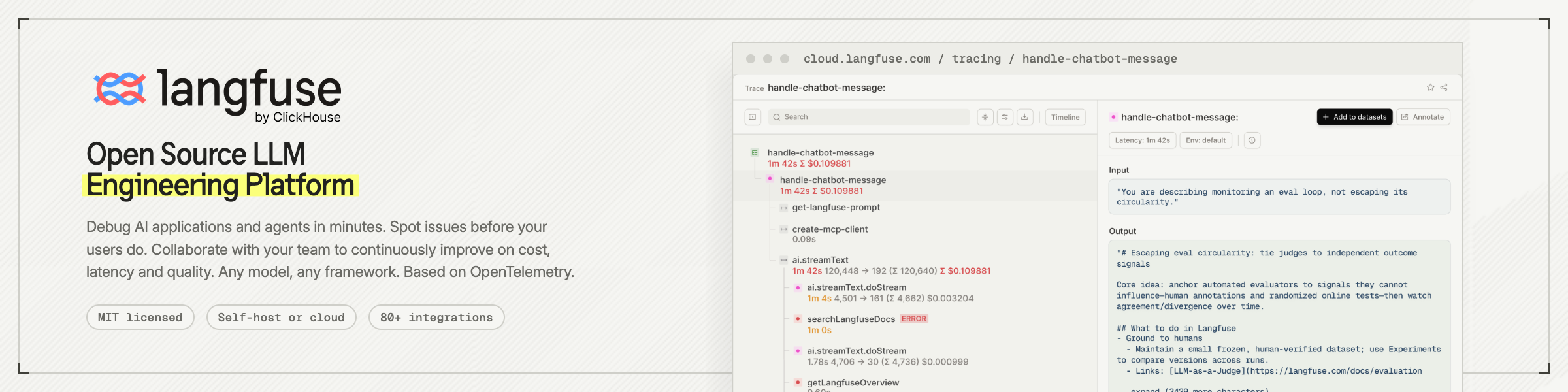




Langfuse is an open source LLM engineering platform. It helps teams collaboratively develop, monitor, evaluate, and debug AI applications. Langfuse can be self-hosted in minutes and is battle-tested. Proudly made with ClickHouse open source database.
🧑💻 We're hiring
Langfuse is growing fast (we doubled the team in the last 6 months). Since January 2026 we're part of ClickHouse. We hire remotely, with offices in Berlin, San Francisco, Amsterdam, and New York. We hire engineers who love open source and great developer experiences. See open roles →
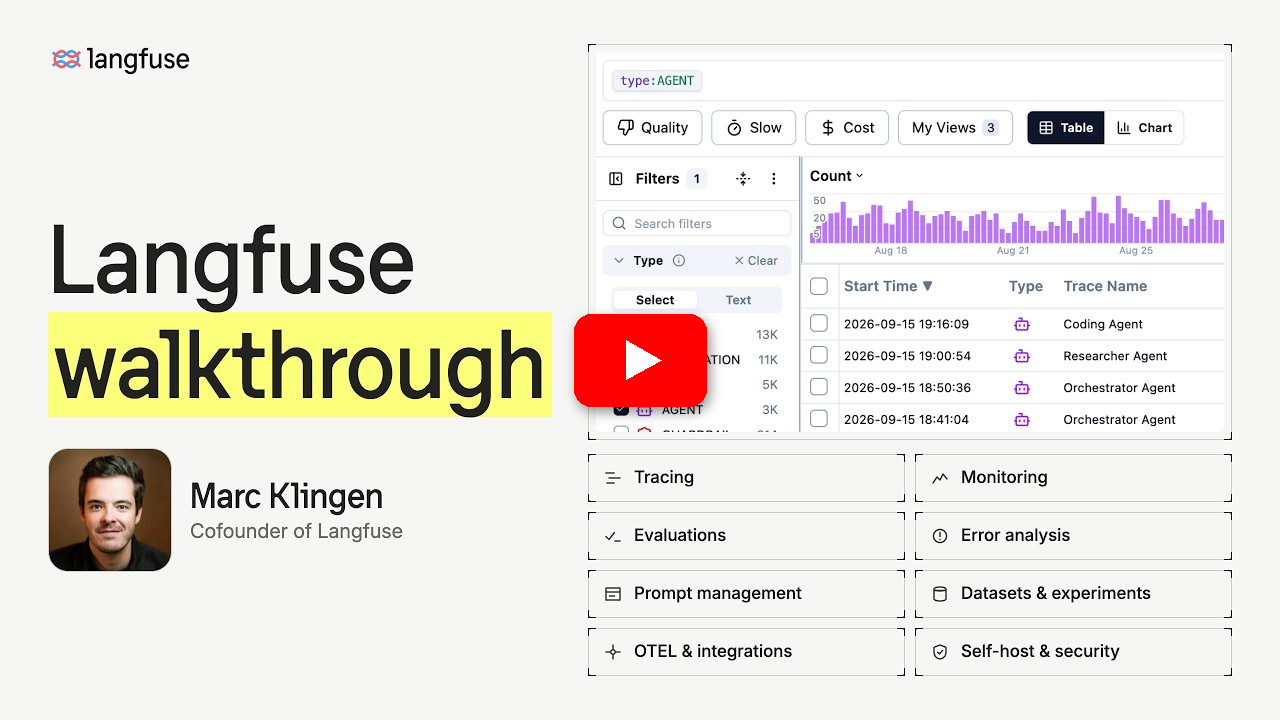
✨ Core Features
-
LLM Application Observability: Instrument your app and start ingesting traces to Langfuse, thereby tracking LLM calls and other relevant logic in your app such as retrieval, embedding, or agent actions. Inspect and debug complex logs and user sessions. Try the interactive demo to see this in action.
-
Prompt Management helps you centrally manage, version control, and collaboratively iterate on your prompts. Thanks to strong caching on server and client side, you can iterate on prompts without adding latency to your application.
-
Evaluations are key to the LLM application development workflow, and Langfuse adapts to your needs. It supports LLM-as-a-judge, Code evaluators, user feedback collection, manual labeling, and custom evaluation pipelines via APIs/SDKs.
-
Datasets enable test sets and benchmarks for evaluating your LLM application. They support continuous improvement, pre-deployment testing, structured experiments, flexible evaluation, and seamless integration with frameworks like LangChain and LlamaIndex.
-
LLM Playground is a tool for testing and iterating on your prompts and model configurations, shortening the feedback loop and accelerating development. When you see a bad result in tracing, you can directly jump to the playground to iterate on it.
-
Comprehensive API: Langfuse is frequently used to power bespoke LLMOps workflows while using the building blocks provided by Langfuse via the API. OpenAPI spec, Postman collection, and typed SDKs for Python, JS/TS are available.
📦 Deploy Langfuse
Langfuse Cloud
Managed deployment by the Langfuse team, generous free-tier, no credit card required.

Self-Host Langfuse
Run Langfuse on your own infrastructure:
- Local (docker compose): Run Langfuse on your own machine in 5 minutes using Docker Compose.
```bash # Get a copy of the latest Langfuse repository git clone --depth=1 https://github.com/langfuse/langfuse.git cd langfuse
# Run the langfuse docker compose docker compose up ```
- VM: Run Langfuse on a single Virtual Machine using Docker Compose.
- Kubernetes (Helm): Run Langfuse on a Kubernetes cluster using Helm. This is the preferred production deployment.
- Terraform Templates: AWS, Azure, GCP
See self-hosting documentation to learn more about architecture and configuration options.
Docker log rotation
The default docker-compose.yml inherits the Docker daemon's logging configuration. Docker's default json-file driver does not rotate logs unless configured, which can exhaust disk space. Set its max-size and max-file options, or keep your chosen logging backend and configure retention there. Do not rotate or truncate Docker-managed JSON log files with external tools.
After changing daemon logging defaults, restart Docker and recreate existing containers to apply them; restarting containers alone is insufficient. Plan for interruption and preserve data volumes. These settings cover container stdout/stderr, not database data volumes or ClickHouse's internal log files.
[!TIP] Self-hosting Langfuse? Subscribe to the self-hosting update list to get an email about important features and new releases for open source Langfuse — self-hosting updates only, no marketing.
🔌 Integrations
Main Integrations:
| Integration | Supports | Description |
|---|---|---|
| SDK | Python, JS/TS | Manual instrumentation using the SDKs for full flexibility. |
| OpenAI | Python, JS/TS | Automated instrumentation using drop-in replacement of OpenAI SDK. |
| Langchain | Python, JS/TS | Automated instrumentation by passing callback handler to Langchain application. |
| [LlamaIndex](https://langfuse.com/docs/integr |
📈 近 7 天 Star 趋势
🏆 排名变化趋势
📋 历史上榜记录
| 日期 | 榜单 | 排名 | 周期新增 | 总 STAR |
|---|