📄 仓库 README
在 GitHub 查看 ↗ # git-bug
[![Build Status][ci/badge]][ci/url]
[![Backers on Open Collective][backers/badge]][oc]
[![Sponsors on Open Collective][sponsors/badge]][oc]
[![GPL v3 License][license/badge]][license/url]
[![GoDoc][godoc/badge]][godoc/url]
[![Matrix][matrix/badge]][matrix/url]
[Issues] - [Documentation][doc] - [Discussions][discuss]
git-bug is a bug tracker that:
- is fully integrated in git: you only need your git repository to have a bug tracker
- is distributed: use your normal git remote to collaborate, push and pull your bugs!
- works offline: in a plane or under the sea? Keep reading and writing bugs!
- prevents vendor lock-in: your usual service is down or went bad? You already have a full backup.
- is fast: listing bugs or opening them is a matter of milliseconds
- doesn't pollute your project: no files are added in your project
- integrates with your tooling: use the UI you like (CLI, terminal, web) or integrate with your existing tools through the CLI or the GraphQL API
- bridges to other bug trackers: use bridges to import and export to other trackers.
Installation
See INSTALLATION.md for the complete guide, including how to build from source and verify your install.
Workflows
There are multiple ways to use git-bug. See the workflow documentation for the details.
Native workflow
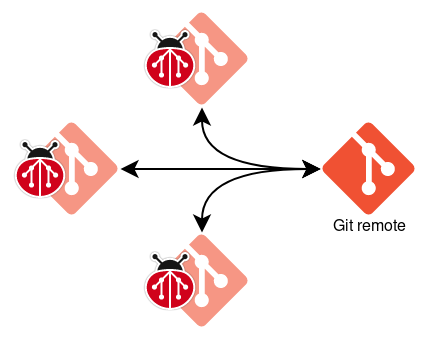
Bridge workflow

Web UI workflow (WIP)
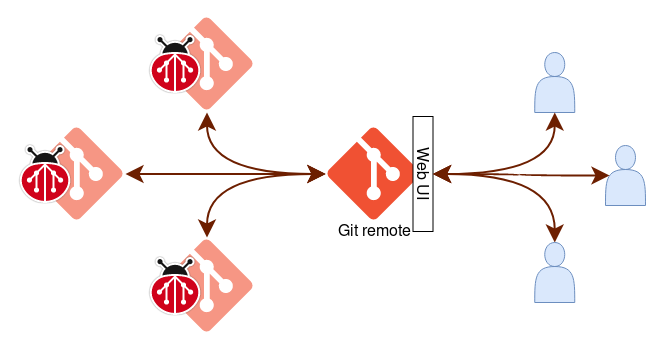
CLI usage
Create a new identity:
git bug user new
Create a new bug:
git bug add
Your favorite editor will open to write a title and a message.
You can push your new entry to a remote:
git bug push [<remote>]
And pull for updates:
git bug pull [<remote>]
List existing bugs:
git bug ls
Filter and sort bugs using a query:
git bug ls "status:open sort:edit"
Search for bugs by text content:
git bug ls "foo bar" baz
You can now use commands like show, comment, open or close to display and modify bugs. For more details about each command, you can run git bug <command> --help or read the command's documentation.
Interactive terminal UI
An interactive terminal UI is available using the command git bug termui to browse and edit bugs.
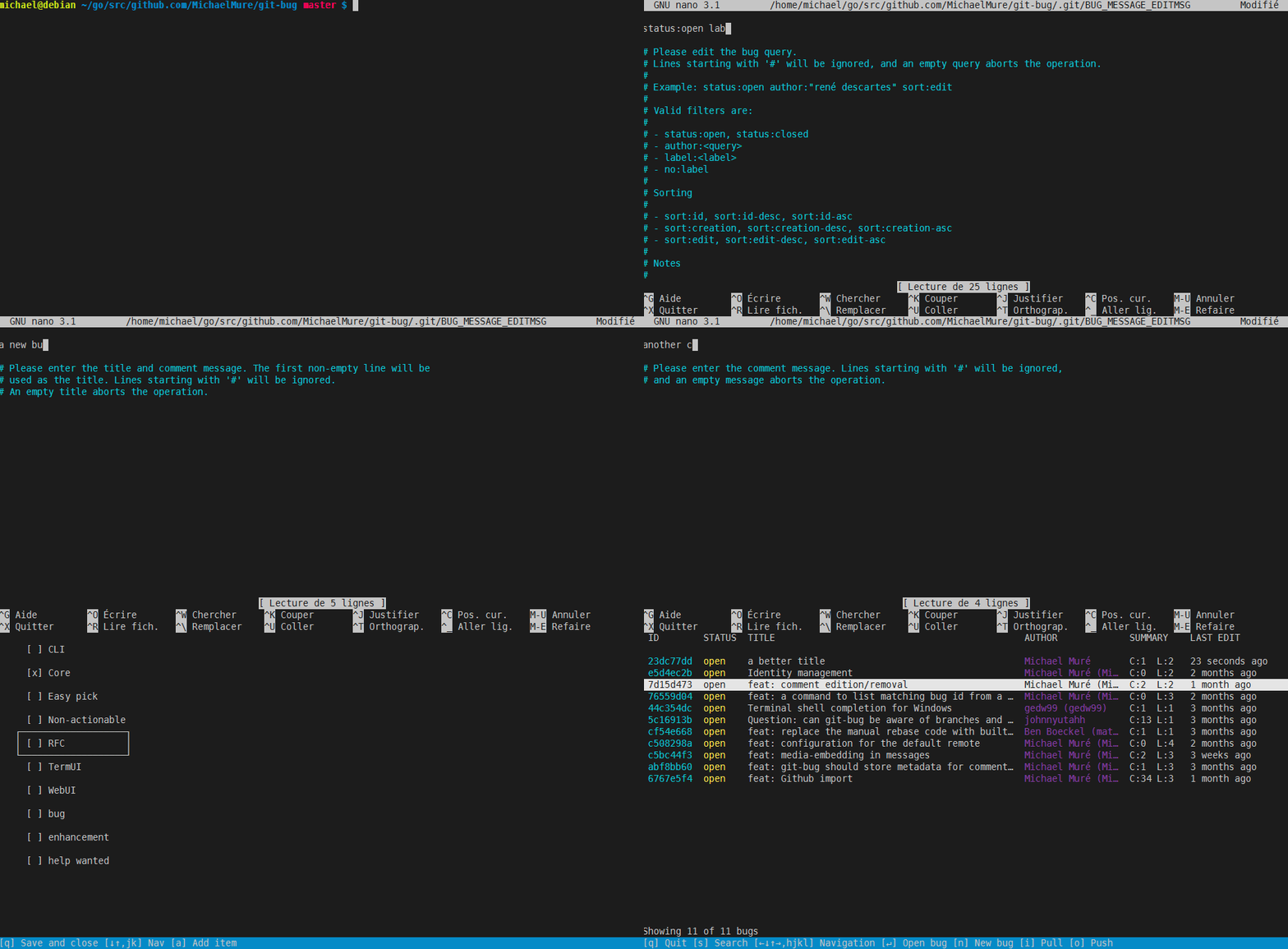
Web UI
You can launch a rich Web UI with git bug webui. Browse, search and filter issues, open new ones, comment, and edit titles, labels and status. It also doubles as a code browser for your repository, with a file tree, syntax-highlighted files, commit history and diffs.
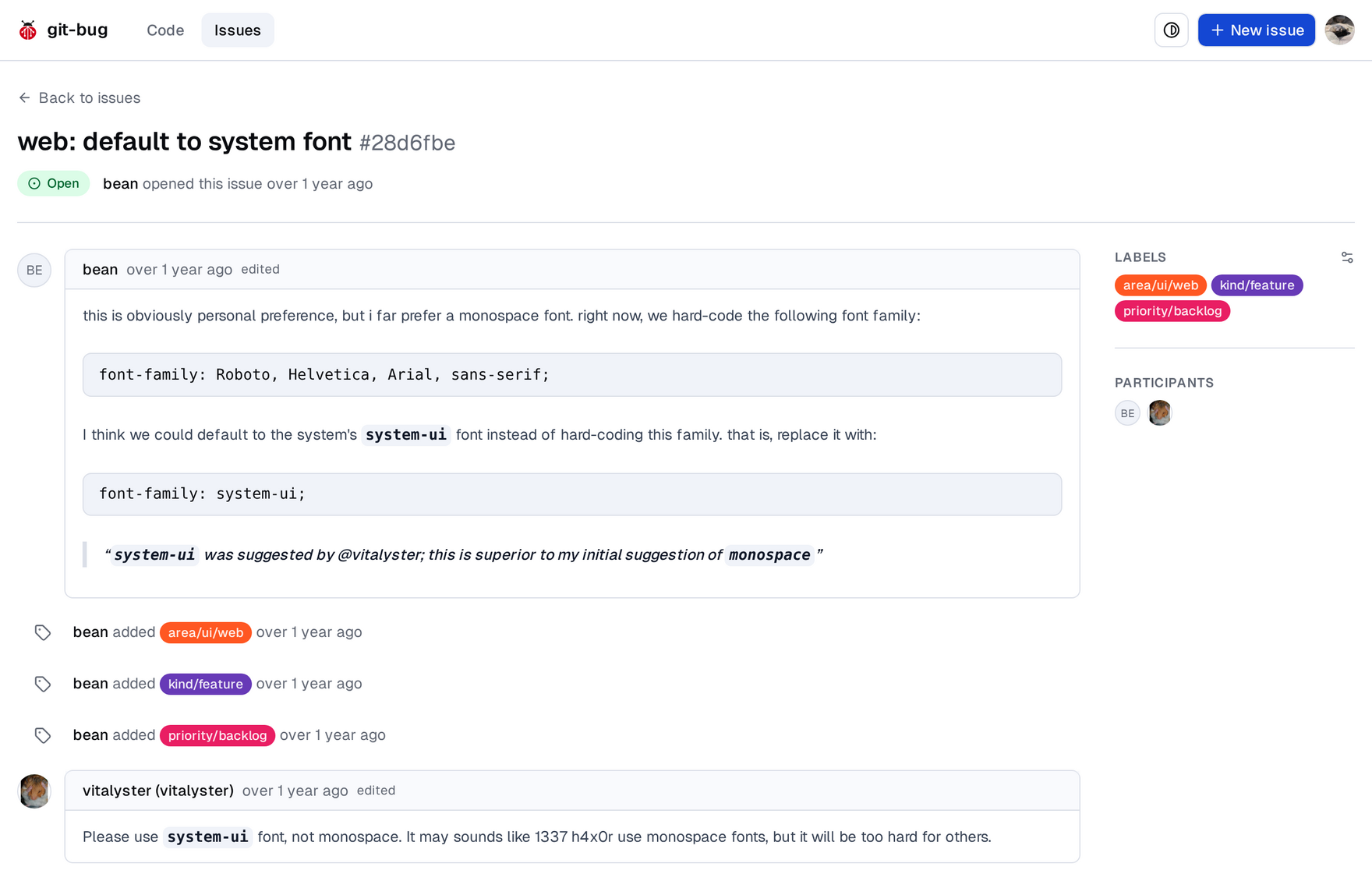
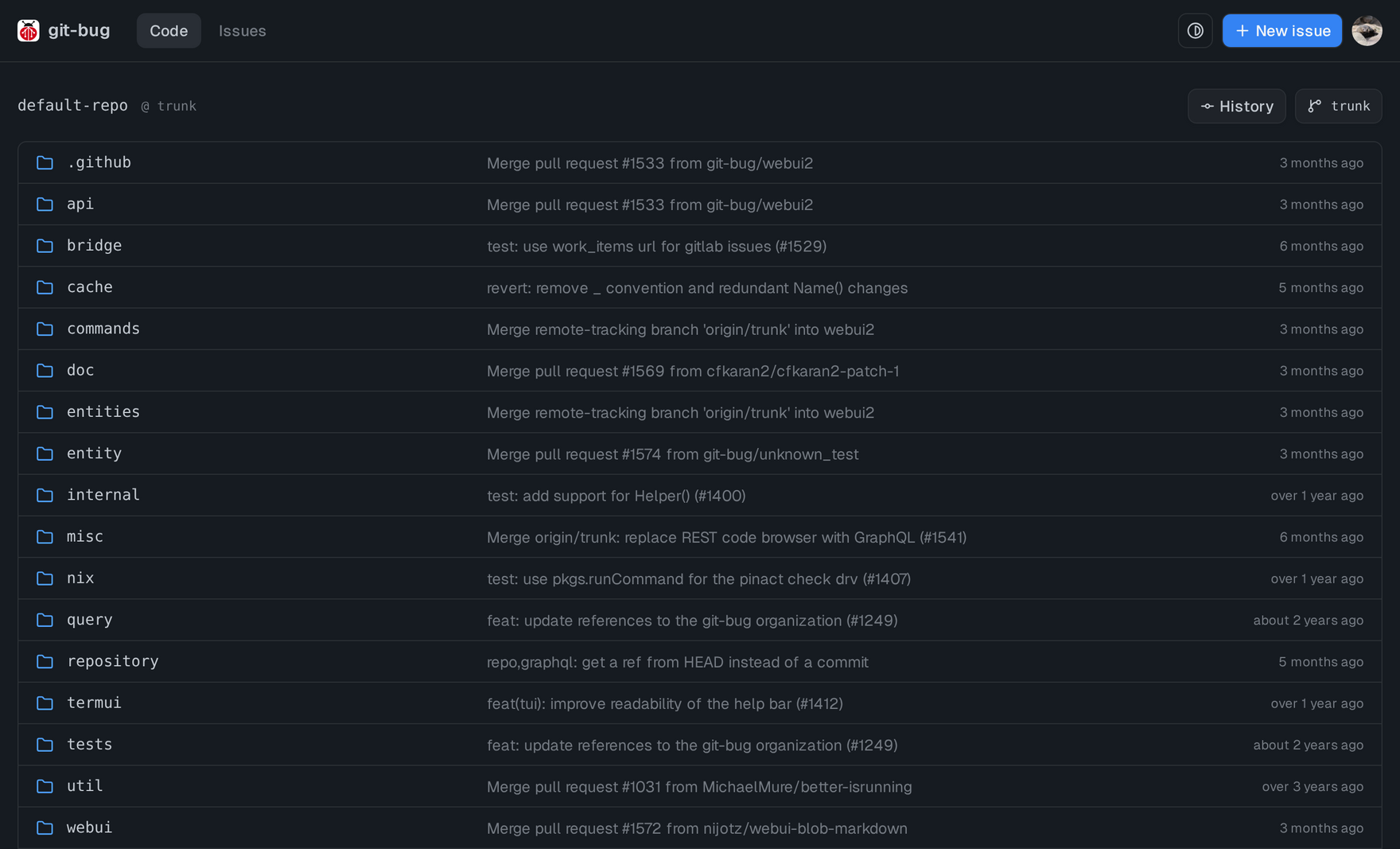
The web UI is packed inside the same go binary and served by a local http server. It talks to the backend through a GraphQL API, whose schema is available here.
Bridges
git-bug can import from and export to Github, Gitlab, Jira and Launchpad. See the feature matrix for what each bridge supports, and the bridge documentation for the full guide.
Interactively configure a new bridge:
git bug bridge new
Or manually:
git bug bridge new \
    --name=<bridge> \
    --target=github \
    --url=https://github.com/git-bug/git-bug \
    --login=<login> \
    --token=<token>
Import bugs:
git bug bridge pull [<name>]
Export modifications:
git bug bridge push [<name>]
Delete a bridge:
git bug bridge rm [<name>]
Internals
Interested in how it works? Have a look at the data model and the internal bird-view.
The on-disk format is formally specified in the git-bug spec, covering the DAG entity format, identities and the bug entity. Read that if you want to write another implementation or a tool that reads git-bug data directly.
Or maybe you want to make your own distributed data-structure in git?
See also all the docs.
Misc
Planned features
The feature matrix gives a good overview of what is planned, without being exhaustive.
Additional planned features:
- webUI that can be used as a public portal to accept user's input
- inflatable raptor
Contribute
PRs accepted. Drop by the Matrix room for a chat, look at the feature matrix or browse the issues and discussions to see what is worked on or discussed.
See CONTRIBUTING.md to get a development environment going, build the project and run the tests. To work on the web UI, have a look at its dedicated README.
Contributors :heart:
This project exists thanks to all the people who contribute.

Backers & sponsors
Thank you to all our backers and sponsors! 🙏 [Become a backer or sponsor]


License
Unless otherwise stated, this project is released under the GPLv3 or later license © Michael Muré.
The git-bug logo by Viktor Teplov is released under the Creative Commons Attribution 4.0 International (CC BY 4.0) license © Viktor Teplov.
📈 近 7 天 Star 趋势
🏆 排名变化趋势
📋 历史上榜记录
| 日期 | 榜单 | 排名 | 周期新增 | 总 STAR |
|---|