📄 仓库 README
在 GitHub 查看 ↗
Open Ontologies
Plan a change to a production ontology. See every consequence before you apply it.
Then give the reviewer a proof that they can check without trust in you.
Open Ontologies is written in Rust. It ships as one binary.





English · 简体中文

Put in one spreadsheet. Get one ontology, with the evidence for each line. Then change one cell, and see the shape find the error. The page runs the released binary.
Look for enterprise support? tesseractsemantics.com
The engine is MIT, and it stays MIT. The platform is the hosted version of the engine.

426 asserted, 259 certified, 1 rejected. The engine derived the green edges. A Lean 4 checker then proved them. One certificate holds all 259, and one run of the checker accepts it. The red edge is a forged line. The same checker refused that line, gave exit 1, and named the rule. The run supplies each count. Nobody writes a count into the caption.
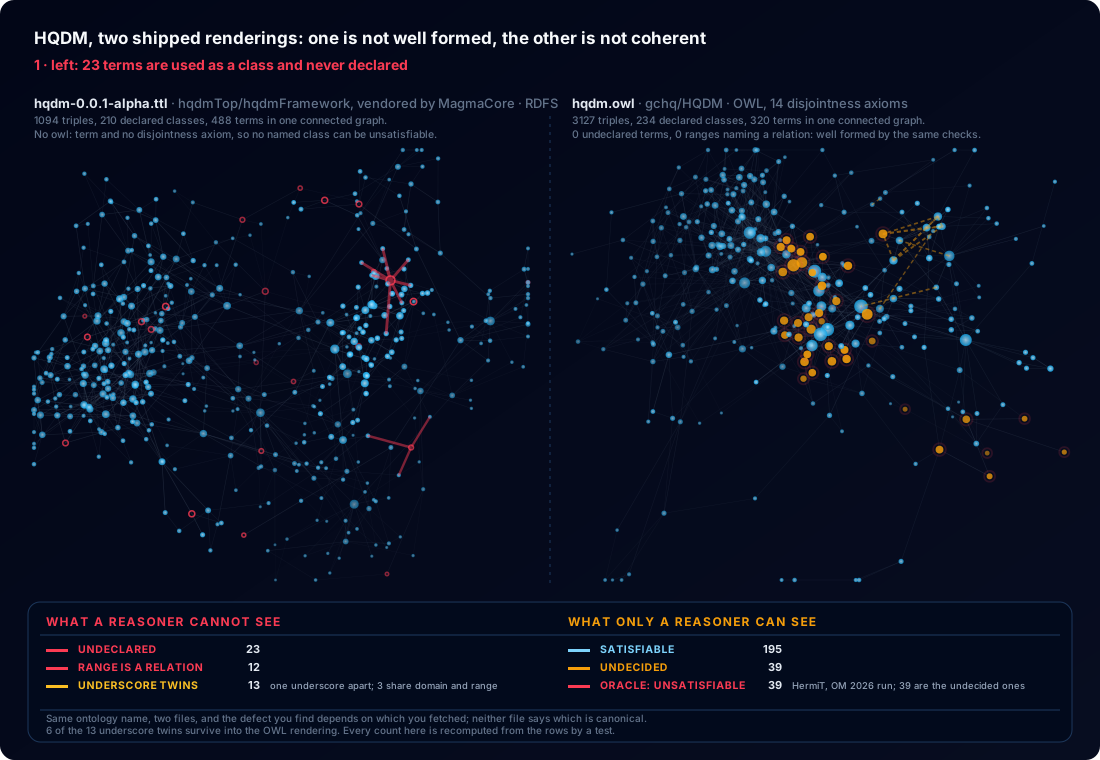
The same machinery, on a file from a different group, two times. HQDM ships as two files.
hqdmTop/hqdmFramework publishes an RDFS file. MagmaCore keeps a copy of that file, byte
for byte. gchq/HQDM publishes an OWL file. The two files fail different checks. The RDFS
file has no owl: term and no disjointness axiom. Thus no named class in that file can be
unsatisfiable. But the file has 23 terms that it uses as a class and never declares. It has
12 rdfs:range declarations that name a relation and not a class. It also has 13
pairs of names that differ by one final underscore. Three of those pairs have the same domain and the
same range. The OWL file passes all three checks, and the OWL file is not coherent. The tableaux of
this engine finds 190 of its named classes satisfiable. The tableaux finds 39 unsatisfiable.
HermiT calls the same 39 unsatisfiable, and HermiT is an opinion in the vocabulary of this
repository. This figure proves nothing, and the figure does not claim a proof. A test computes each
count again, and the test also computes that intersection. For the source and the method, read
docs/assets/hqdm/PROVENANCE.md.
One triple. Nothing added, nothing removed, blast radius zero. 901 consequences that were not there before.
$ printf 'load base.ttl\nplan proposed.ttl\n' | open-ontologies batch -
#   the whole change:  ex:hasParent rdfs:domain ex:Person

added_classes         0
removed_classes       0
blast_radius          0 triples affected
risk_score            low
                      ────────────────────────────────────────────
conservativity        not_conservative_under_rule_table
new consequences      901          rule table owl-rl, in 0.04s
Each number from a shape diff tells you that this change is safe. But the change gave a new type to each individual that the property already had. The tool closes this gap. A text diff cannot show you the gap. The change is one correct line, and the text diff is one line long.
Then give the reviewer the proof. The run writes a certificate. A different
person re-verifies months later. That person needs no instance of this software
and no network. The command is oo-cert asserted.tsv derivations.tsv. The exit
code is 0, and the theorem OOCert.certificate_sound covers the result.
The checker also refuses a forged proof. Write a false conclusion into the derivation file. The same checker exits 1 and names the rule that does not hold. This is the red edge in the figure above. This refusal, and not the headline, is the part that survives examination.
This is not an ontology editor. Use Protégé to draw class hierarchies. You run Open Ontologies on the change, before the change goes to production.
The tool is like Terraform, and this is on purpose. But the plan checks what a change means and what it breaks, not only its text. A text diff is
git diff, and you havegit diffalready.
You do not need a JVM. You do not need Protégé. The engine speaks MCP to Claude, to Cursor, and to other clients of that protocol.
See the engine at work
Three triples go in, and three triples come out. A person asserted only that
ex:Northwind is in a sanctioned jurisdiction. The engine derived the need for
enhanced due diligence. A different person can check that derivation. That person
does not have to trust you, or this engine, or the model that wrote the ontology.
Watch the last seconds. Somebody forges one conclusion, and leaves the two
premises exactly as they were. The same checker refuses the conclusion and names
the rule. oo-horn printed each line in that terminal for the fixtures in
tests/fixtures/horn/supplier/. A test runs the
checker again. The test fails if the figure and the checker do not agree.
With a proof, and without a proof
| An ordinary reasoner | Open Ontologies | |
|---|---|---|
| The answer | Northwind needs enhanced due diligence |
the same answer |
| Why the answer holds | "the reasoner says so" | a certificate that names each rule and each premise |
| Who can check the answer | a second implementation can agree, and some reasoners give an explanation. No verified checker accepts either one | anybody, with a checker that shares no code with the engine |
| If the engine has a defect | a second implementation can disagree. Then you know only that one of the two is wrong | the checker refuses the answer, exit 1 |
| If a person edits the output | you cannot find the edit | the checker refuses it, and names the line and the rule |
| If a rule was yours, not the standard's | the report is the same | a different verdict word, and a test holds that word |
| What an auditor receives | a screenshot | a file that the auditor can check again |
| Guarantee on an unsatisfiability answer | asserted | none, and the tool says so |
If the tool measures a property, the tool says measured. If a prover gives an opinion, that opinion never takes the vocabulary of the checker. Read what the tool proves, and what it does not prove.
What the tool does
| Capability | What you get |
|---|---|
| Reason over OWL and RDFS | Materialised inferences and a derivation certificate that a proved checker accepts |
| Use your own rules | SWRL, RIF Core or a Horn table, evaluated, with a verdict word that says the rules were yours |
| Validate against SHACL | A report from an evaluator with a measurement against the W3C suite, not an assertion of success |
| Ask if something is satisfiable | A f |
📈 近 7 天 Star 趋势
🏆 排名变化趋势
📋 历史上榜记录
| 日期 | 榜单 | 排名 | 周期新增 | 总 STAR |
|---|