📄 仓库 README
在 GitHub 查看 ↗





Your vault is the memory. Claude, Grok Bot, Codex - same brain.
Your vault outlives whichever CLI you switch to.





obsidian-second-brain: AI second brain for Obsidian - persistent memory for Claude Code, Codex, Cursor and Grok Bot
Crew: one logbook for all your agents
Crew works without Obsidian. Claude Code, Codex, Cursor, and Grok Bot share job records in any plain folder. Each agent sees what the others finished and can leave a lesson for review.
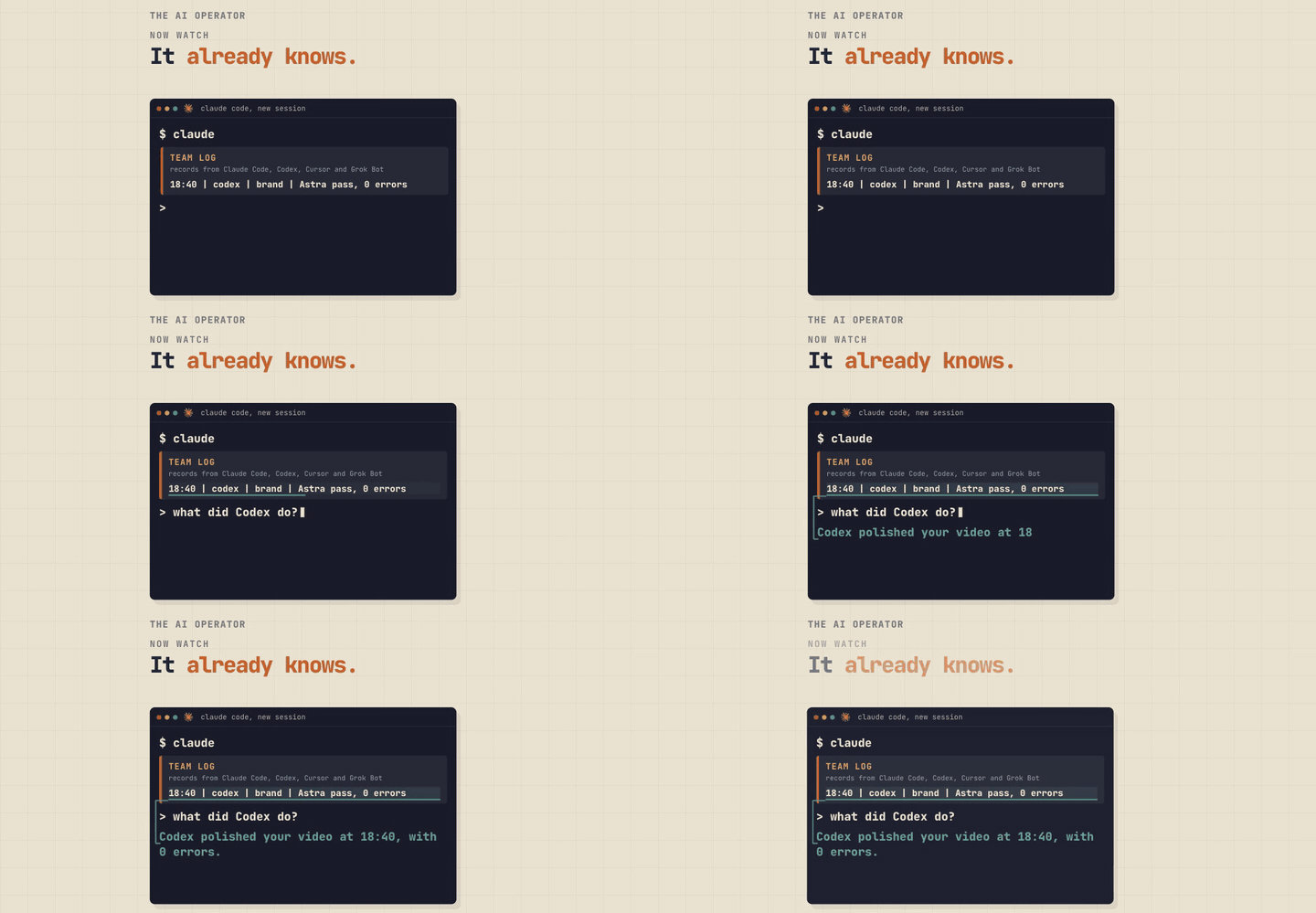
- Grok Bot joins the same team through its existing runner.
- A lesson becomes a rule only when a human runs
keep. - Crew runs no background loop.
curl -fsSL https://raw.githubusercontent.com/eugeniughelbur/obsidian-second-brain/main/scripts/quick-install.sh | bash
Restart Claude Code, then type /crew setup. Pick ~/crew or wiki/team/ inside your Obsidian vault.
Codex users run /hooks once to trust Crew's hooks. Setup prints a Grok Bot profile block to paste.
18:40 | codex | brand | Astra pass, 0 errors
Setup, exact commands, and limits. Python 3.10 or later; no extra packages for Crew. Shared agent memory isn't new. What Crew adds is the three parts above.
An evolution of Karpathy's LLM Wiki pattern: a vault that rewrites itself.
Every source updates existing pages instead of just appending new ones. Contradictions reconcile automatically. Your vault compounds while you sleep.
Powered by OKM - Open Knowledge Metabolism: every stored fact is timeless, dated, or a pointer - so your knowledge base never fills with facts that used to be true.
Built for developers · founders and operators · writers · researchers - pick a preset at setup
Start with three: /obsidian-init to set up, /obsidian-save to capture, /obsidian-find to recall. The other 42 are there when you need them.
auto-synthesis · thinking tools that argue with you
live research from X, the web, and YouTube · 4 scheduled agents · 4 role presets
write-time AI-first validator · /create-command interview flow · multilingual trigger schema
Install → ·
Demos ·
See it in action ·
All commands ·
Presets ·
OKM ·
Discussions

One /obsidian-save - five cross-linked notes. Real footage, synthetic vault. More demos →
If this looks useful, star the repo. It is how other people find it.
v0.18 - Crew (October 2026): Claude Code, Codex, Cursor and Grok Bot now share one logbook, so each agent knows what the others did.
One line per job in any plain folder or your vault, read through each agent's own hooks; lessons agents leave each other become rules only when you keep them; no background loop. Plus source quality labels and German triggers from contributors.
See the changelog →
The Problem
You use Claude every day. Every session starts from scratch. You re-explain everything. The conversation ends. Everything disappears. Claude Code has no persistent memory across sessions - and neither does Grok Bot, Codex, Gemini, or any of the others.
You take notes in Obsidian. Hundreds of files. They just sit there. You make the same decision twice because you forgot you made it six months ago. Ideas rot in daily notes. Nobody connects the dots.
Two powerful tools. Completely disconnected. You already have the long-term memory. The thing doing the thinking cannot reach it.
How this extends Karpathy's LLM Wiki
Karpathy's pattern is brilliant. Drop sources, LLM creates wiki pages, ask questions. This skill takes it further:
| Karpathy's LLM Wiki | obsidian-second-brain | |
|---|---|---|
| New sources | Append new pages, cross-reference | Rewrite existing pages. People get updated, claims revised, stale facts replaced. |
| Contradictions | Flagged, you resolve manually | /obsidian-reconcile resolves them automatically |
| Patterns | Surface when you ask | /obsidian-synthesize finds unnamed patterns and writes synthesis pages on its own |
| When it runs | On demand, when you prompt | 4 scheduled agents: morning brief, nightly consolidation, weekly review, vault-health check |
| Note format | Human-readable wiki pages | AI-first: ## For future agent preamble + frontmatter for LLM retrieval, not human review |
If Karpathy's wiki is a knowledge base you maintain with an LLM, this is a knowledge base that maintains itself.
What Happens When You Install This
After a meeting: /obsidian-save
Claude pulls out every decision, person, task, and idea and saves each one to the right note. You do nothing.
You recorded a voice memo: /obsidian-ingest meeting.m4a
Claude transcribes it with a local Whisper install, attributes speakers where the transcript makes them identifiable, extracts every promise and action item, and distributes across entity pages, task boards, and the daily note.
You screenshot a whiteboard: /obsidian-ingest photo.png
Claude reads the image, extracts text and structure, creates concept notes, links to related projects. A photo becomes knowledge.
You have a finished text document: /obsidian-ingest report.docx
Word (.docx, .doc) and OpenDocument (.odt) files uploaded or copied into the vault follow the same local-source rules as PDFs and Markdown. The helper converts a private copy to a temporary PDF, then ingestion uses the existing PDF path. Text and figures use that path; comments and revision markup are excluded. The original stays unchanged and remains the source under the existing provenance rules. Requires Python 3.10+ and LibreOffice 26.2+, installed separately. Run python scripts/document_to_pdf.py "path/to/report.docx"; it prints the PDF path. Put soffice on PATH or add --soffice with its executable path (Windows: C:/Program Files/LibreOffice/program/soffice.com; macOS: /Applications/LibreOffice.app/Contents/MacOS/soffice). Remove the generated PDF and its temporary parent folder after capture. No additional Python packages are needed. See the ingest command. Presentation and spreadsheet formats remain outside scope.
You find a great video: /obsidian-ingest https://youtube.com/...
Claude doesn't summarize into one note. It REWRITES your existing pages. People get updated. Contradictions get resolved. Patterns trigger new synthesis pages. One URL in. The vault is smarter.
Before a big decision: /obsidian-challenge
Claude searches your vault for past failures and reversed decisions on the same topic. Pushes back with your own words. Your vaul
📈 近 7 天 Star 趋势
🏆 排名变化趋势
📋 历史上榜记录
| 日期 | 榜单 | 排名 | 周期新增 | 总 STAR |
|---|