📄 仓库 README
在 GitHub 查看 ↗
Read this in other languages
English | 简体中文 | 日本語 | 한국어 | Deutsch | Français | Español | हिन्दी | Português | Русский | العربية | فارسی | Italiano | Polski | Nederlands | Türkçe | Українська | Tiếng Việt | Bahasa Indonesia | Svenska | Ελληνικά | Română | Čeština | Suomi | Dansk | Norsk | Magyar | ภาษาไทย | Oʻzbekcha | 繁體中文 | Filipino | עברית









Cut agent token spend by 80%. Graphify Cloud is always-on memory that governs your agents, keeps code quality high, and proves correctness with formal verification. Start a free 14-day trial →
Type /graphify in your AI coding assistant and it maps your entire project (code, docs, PDFs, images, videos) into a knowledge graph you can query instead of grepping through files.
- Code maps for free, fully local. Code is parsed with tree-sitter AST: deterministic, no LLM, nothing leaves your machine. (Docs, PDFs, images and video use your assistant's model, or a configured API key, for a semantic pass.)
- Every edge is explained. Each connection is tagged
EXTRACTED(explicit in the source) orINFERRED(resolved by graphify), so you can tell what was read directly from what was inferred. - Not a vector index. No embeddings, no vector store: a real graph you traverse. Ask a question, trace the path between two things, or explain one concept.
[!NOTE] Want this always-on? Graphify Cloud keeps the graph live across your entire SDLC: monorepo and cross-repo support, formal verification, and code review with a bird's-eye view of your SDLC, plus connectors for Sentry, Jira, and more so incidents and tickets sit in the same graph as your code. Start a free 14-day trial at app.graphify.com.
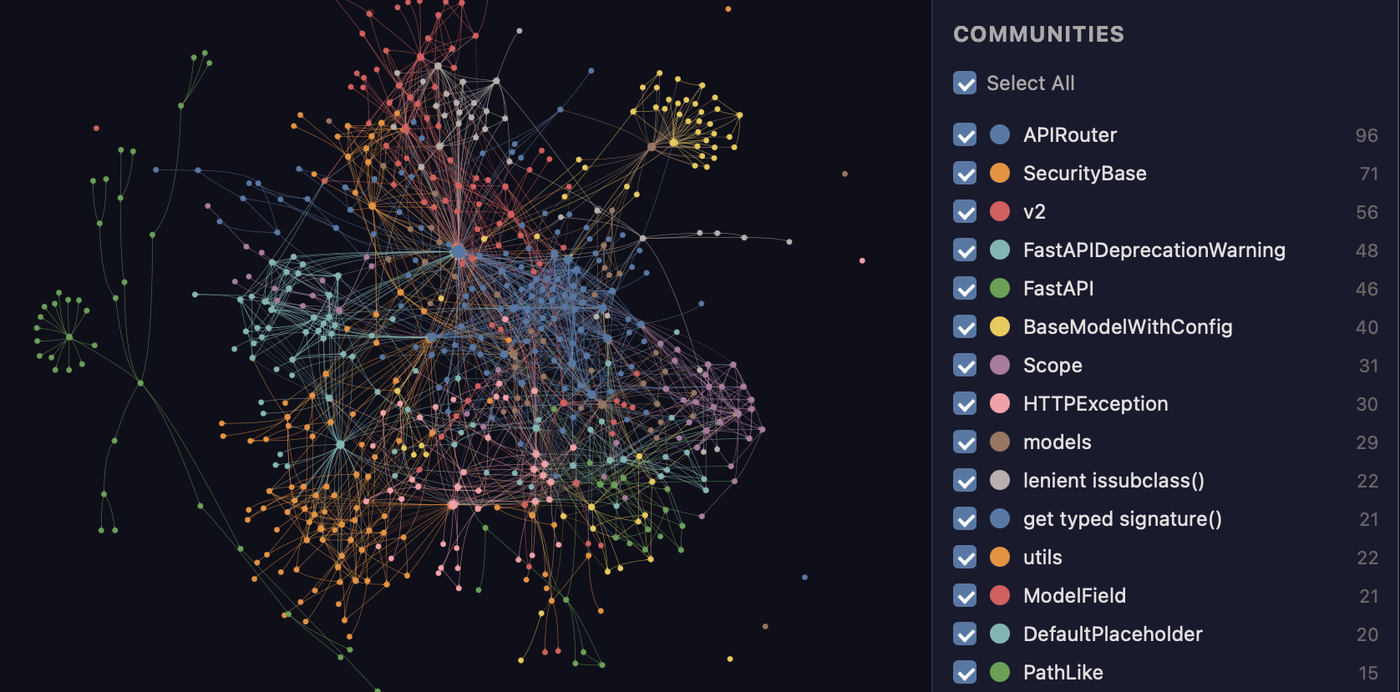
The FastAPI codebase mapped by graphify. Every node is a concept, colors are detected communities, and the whole thing is clickable in graph.html.
Get started (30 seconds). Needs Python 3.10+ and uv (or pipx):
uv tool install graphifyy      # install the CLI (or: pipx install graphifyy)
graphify install               # detects your assistant and registers the skill
Then, in your AI assistant:
/graphify .
That's it. You get three files:
graphify-out/
├── graph.html       open in any browser: click nodes, filter, search
├── GRAPH_REPORT.md  the highlights: key concepts, surprising connections, suggested questions
└── graph.json       the full graph: query it anytime without re-reading your files
The persisted graph includes graph.schema_version so integrations can detect
incompatible format changes, plus graph.graphify_version identifying the
Graphify release that produced it.
One install, any assistant, any OS. Claude Code, Cursor, Codex, Gemini CLI, GitHub Copilot, and 20+ more, on macOS, Linux, and Windows: pick your platform.
See it in action

Once the graph is built you query it instead of reading files. Real output, graphify run on the FastAPI codebase shown above:
$ graphify explain "APIRouter"
Node: APIRouter
  Source:    routing.py L2210
  Community: 2
  Degree:    47

Connections (47):
  --> RequestValidationError [uses] [INFERRED]
  --> Dependant [uses] [INFERRED]
  --> .get() [method] [EXTRACTED]
  <-- __init__.py [imports] [EXTRACTED]
  ...

$ graphify path "FastAPI" "ModelField"
Shortest path (3 hops):
  FastAPI --uses--> DefaultPlaceholder <--references-- get_request_handler() --references--> ModelField
Every edge carries a confidence tag (EXTRACTED = explicit in the source, INFERRED = derived by resolution), so you can tell what was read directly from what was inferred. graphify query "<question>" returns a scoped subgraph for a plain-language question, and graphify path A B traces how any two things connect, ending with the path's overall confidence: that of its weakest hop.
What it does
What you get out of the box:
| Capability | What you get |
|---|---|
| God nodes | The most-connected concepts, so you see what everything flows through |
| Communities | The graph split into subsystems (Leiden), with LLM-free labels |
| Cross-file links | calls / imports / inherits / mixes_in resolved across ~40 languages via tree-sitter AST |
| Query, path, explain | Ask a question, trace the path between two things, or explain one concept, all against graph.json |
| Rationale + doc refs | # NOTE: / # WHY: comments and ADR/RFC citations become first-class nodes linked to the code |
| Beyond code | Docs, PDFs, images, and video/audio all map into the same graph |
| Local-first | Code is parsed locally with tree-sitter (no LLM, nothing leaves your machine); only the semantic pass over doc |
📈 近 7 天 Star 趋势
🏆 排名变化趋势
📋 历史上榜记录
| 日期 | 榜单 | 排名 | 周期新增 | 总 STAR |
|---|